Back
Back
Problem 3.7.53
In Exercises 53 and 54, find both dy/dx (treating y as a differentiable function of x) and dx/dy (treating x as a differentiable function of y). How do dy/dx and dx/dy seem to be related?
53. xy³ + x²y = 6
Problem 3.9.14c
Use the linear approximation (1 + x)ᵏ ≈ 1 + kx to find an approximation for the function f(x) for values of x near zero.
c. f(x) = 1/√(1 + x)
Problem 4.7.41
Finding Indefinite Integrals
In Exercises 17–56, find the most general antiderivative or indefinite integral. You may need to try a solution and then adjust your guess. Check your answers by differentiation.
∫(cscθ cotθ) / 2 dθ
Problem 4.5.6
6. You are planning to close off a corner of the first quadrant with a line segment 20 units long running from (a, 0) to (0,b). Show that the area of the triangle enclosed by the segment is largest when a = b.
Problem 4.8
In Exercises 1–10, find the extreme values (absolute and local) of the function over its natural domain, and where they occur.
__________
y = √ 3 + 2𝓍 ―𝓍²
Problem 4.7.71
Initial Value Problems
Solve the initial value problems in Exercises 71–90.
dy/dx = 2x − 7, y(2) = 0
Problem 4.4.39
In Exercises 9–66, graph the function using appropriate methods from the graphing procedures presented just before Example 9, identifying the coordinates of any local extreme points and inflection points. Then find coordinates of absolute extreme points, if any.
39. y = 8 / (x² + 4) (Witch of Agnesi)
Problem 4.1.61
Theory and Examples
Maximum height of a vertically moving body The height of a body moving vertically is given by s = −12gt² + υ₀t + s₀, g > 0, with s in meters and t in seconds. Find the body’s maximum height.
Problem 4.3.36
Identifying Extrema
In Exercises 19–40:
a. Find the open intervals on which the function is increasing and those on which it is decreasing.
b. Identify the function’s local extreme values, if any, saying where they occur.
f(x) = x³ / (3x² + 1)
Problem 4.1.50
Finding Critical Points
In Exercises 41–50, determine all critical points and all domain endpoints for each function.
y = x − 3x²ᐟ³
Problem 4.5.42
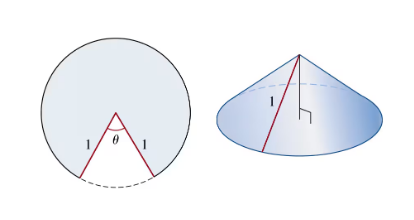
A cone is formed from a circular piece of material of radius 1 meter by removing a section of angle θ and then joining the two straight edges. Determine the largest possible volume for the cone.
Problem 4.7.58
Checking Antiderivative Formulas
Verify the formulas in Exercises 57–62 by differentiation.
∫(3x + 5)⁻² dx = −(3x + 5)⁻¹/3 + C
Problem 4.4.69
Each of Exercises 67–88 gives the first derivative of a continuous function y=f(x). Find y'' and then use Steps 2–4 of the graphing procedure described in this section to sketch the general shape of the graph of f.
69. y' = x(x - 3)²
Problem 4.3.62
Identifying Extrema
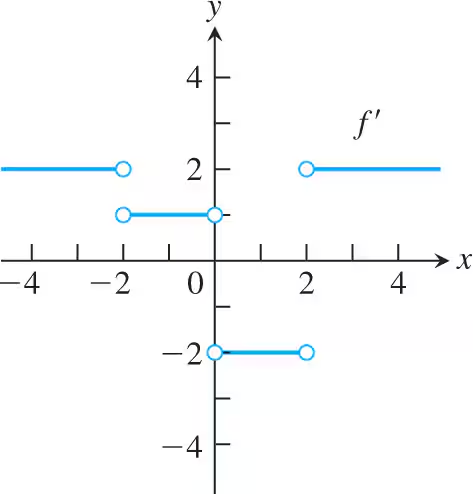
In Exercises 61 and 62, the graph of f' is given. Assume that f is continuous, and determine the x-values corresponding to local minima and local maxima.
Problem 4.2.47
Finding Position from Velocity or Acceleration
Exercises 45–48 give the acceleration a=d²s/dt², initial velocity, and initial position of an object moving on a coordinate line. Find the object’s position at time t.
a = 9.8, v(0) = −3, s(0) = 0
Problem 4.4.117
117. Suppose that the second derivative of the function y = f(x) isy" =(x+1)(x-2).
For what x-values does the graph of f have an inflection point?
Problem 4.3.37
Identifying Extrema
In Exercises 19–40:
a. Find the open intervals on which the function is increasing and those on which it is decreasing.
b. Identify the function’s local extreme values, if any, saying where they occur.
f(x) = x¹ᐟ³(x + 8)
Problem 4.1.9
Finding Extrema from Graphs
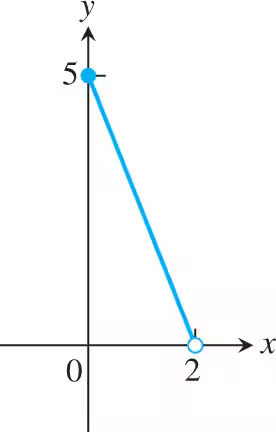
In Exercises 7–10, find the absolute extreme values and where they occur.
Problem 4.7.19
Finding Indefinite Integrals
In Exercises 17–56, find the most general antiderivative or indefinite integral. You may need to try a solution and then adjust your guess. Check your answers by differentiation.
∫(3t² + t/2) dt
Problem 4.3.73
Theory and Examples
Determine the values of constants a and b so that f(x) = ax² + bx has an absolute maximum at the point (1,2).
Problem 4.6.26
[Technology Exercises] When solving Exercises 14–30, you may need to use appropriate technology (such as a calculator or a computer).
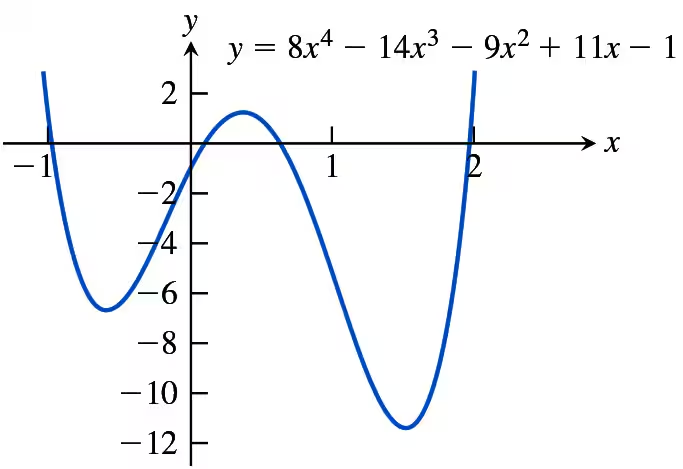
26. Factoring a quartic Find the approximate values of r_1 through r_4 in the factorization
8x^4-14x^3-9x^2+11x-1=8(x-r_1)(x-r_2)(x-r_3)(x-r_4)
Problem 4.5.47
The intensity of illumination at any point from a light source is proportional to the square of the reciprocal of the distance between the point and the light source. Two lights, one having an intensity eight times that of the other, are 6 m apart. How far from the stronger light is the total illumination least?
Problem 4.2.20
Roots (Zeros)
Show that the functions in Exercises 19–26 have exactly one zero in the given interval.
f(x) = x³ + 4x² + 7, (−∞, 0)
Problem 4.7.45
Finding Indefinite Integrals
In Exercises 17–56, find the most general antiderivative or indefinite integral. You may need to try a solution and then adjust your guess. Check your answers by differentiation.
∫(sin2x − csc²x)dx
Problem 4.10
In Exercises 1–10, find the extreme values (absolute and local) of the function over its natural domain, and where they occur.
y = (𝓍 + 1) / (𝓍² + 2𝓍 + 2)
Problem 4.1.21
Absolute Extrema on Finite Closed Intervals
In Exercises 21–36, find the absolute maximum and minimum values of each function on the given interval. Then graph the function. Identify the points on the graph where the absolute extrema occur, and include their coordinates.
f(x) = (2/3)x − 5, −2 ≤ x ≤ 3
Problem 4.5.62
Business and Economics
62. Production level Suppose that c(x)=x^3-20x^2 + 20,000x is the cost of manufacturing x items. Find a production level that will minimize the average cost of making x items.
Problem 4.7.102
Applications
Liftoff from Earth A rocket lifts off the surface of Earth with a constant acceleration of 20 m/sec². How fast will the rocket be going 1 min later?
Problem 4.5.67
Theory and Examples
67. An inequality for positive integers Show that if a, b, c, and d are positive integers, then
[(a^2+1)(b^2+1)(c^2+1)(d^2+1)]/abcd ≥ 16
Problem 4.5.30
30. Find a positive number for which the sum of its reciprocal and four times its square is the smallest possible.