Find the inverse f−1(x)of each function (on the given interval, if specified). f(x)=10−2x
Verified step by step guidance
1
Start by replacing f(x) with y to make the equation easier to work with: y = 10 - 2x.
To find the inverse, swap x and y in the equation. This gives us: x = 10 - 2y.
Solve for y in terms of x. Begin by isolating the term with y: subtract 10 from both sides to get x - 10 = -2y.
Divide both sides by -2 to solve for y: y = (10 - x) / 2.
The inverse function is f^{-1}(x) = (10 - x) / 2. This is the expression for the inverse of the given function.
Verified video answer for a similar problem:
This video solution was recommended by our tutors as helpful for the problem above
Video duration:
2m
Play a video:
0 Comments
Key Concepts
Here are the essential concepts you must grasp in order to answer the question correctly.
Inverse Functions
An inverse function essentially reverses the effect of the original function. If a function f takes an input x and produces an output y, the inverse function f^{-1} takes y as input and returns x. For a function to have an inverse, it must be one-to-one, meaning each output is produced by exactly one input.
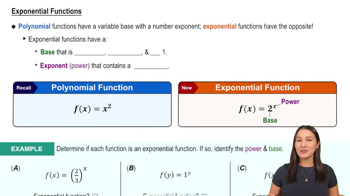
Exponential functions are mathematical expressions in the form f(x) = a * b^x, where a is a constant, b is the base (a positive real number), and x is the exponent. In the given function f(x) = 10^{-2x}, the base is 10, and the exponent is -2x, indicating that the function decreases rapidly as x increases, which is characteristic of exponential decay.
To find the inverse of a function algebraically, you typically start by replacing f(x) with y, then solve for x in terms of y. After isolating x, you swap x and y to express the inverse function. This process often involves manipulating equations, such as applying logarithms to exponential functions, to derive the inverse correctly.

 2:46 minutes
 Verified step by step guidance
 4:49
4:49