Find the inverse f−1(x)of each function (on the given interval, if specified). f(x)=x2+12, for x≥0
Verified step by step guidance
1
Start by setting the function equal to y: y = \(\frac{2}{x^2 + 1}\).
Swap x and y to find the inverse: x = \(\frac{2}{y^2 + 1}\).
Solve for y by first multiplying both sides by (y^2 + 1) to eliminate the fraction: x(y^2 + 1) = 2.
Expand and rearrange the equation to isolate y^2: xy^2 + x = 2, which simplifies to xy^2 = 2 - x.
Divide both sides by x to solve for y^2: y^2 = \(\frac{2 - x}{x}\), and then take the square root of both sides to solve for y, considering the domain x \(\geq\) 0 to ensure y is non-negative.
Verified video answer for a similar problem:
This video solution was recommended by our tutors as helpful for the problem above
Video duration:
3m
Play a video:
0 Comments
Key Concepts
Here are the essential concepts you must grasp in order to answer the question correctly.
Inverse Functions
An inverse function reverses the effect of the original function. If a function f takes an input x and produces an output y, the inverse function f^{-1} takes y back to x. For a function to have an inverse, it must be one-to-one, meaning each output is produced by exactly one input. This property ensures that the inverse function is well-defined.
To find the inverse of a function algebraically, you typically start by replacing f(x) with y. Then, you solve for x in terms of y, and finally, swap the variables to express the inverse as y = f^{-1}(x). This process often involves algebraic manipulation, such as isolating x and may require additional steps like checking the domain and range of the original function.
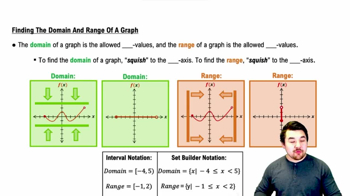
The domain of a function is the set of all possible input values (x-values), while the range is the set of all possible output values (y-values). When finding an inverse function, it is crucial to consider the domain and range of both the original function and its inverse. The range of the original function becomes the domain of the inverse, and vice versa, which can affect the validity of the inverse in certain intervals.