40–62. Choose your test Use the test of your choice to determine whether the following series converge. ∑ (k = 1 to ∞) 1 / k^(1 + p),p > 0
Verified step by step guidance
1
Identify the given series: \( \sum_{k=1}^{\infty} \frac{1}{k^{1+p}} \) where \( p > 0 \). This is a p-series, a common type of series in calculus.
Recall the p-series test: A series of the form \( \sum_{k=1}^{\infty} \frac{1}{k^q} \) converges if and only if \( q > 1 \).
Compare the exponent in the denominator of the given series, which is \( 1 + p \), with 1. Since \( p > 0 \), then \( 1 + p > 1 \).
Apply the p-series test: Because \( 1 + p > 1 \), the series \( \sum_{k=1}^{\infty} \frac{1}{k^{1+p}} \) converges.
Conclude that the series converges for all \( p > 0 \) based on the p-series convergence criterion.
Verified video answer for a similar problem:
This video solution was recommended by our tutors as helpful for the problem above
Video duration:
1m
Play a video:
0 Comments
Key Concepts
Here are the essential concepts you must grasp in order to answer the question correctly.
p-Series Test
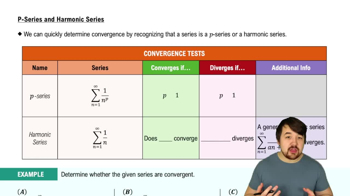
The p-series test determines the convergence of series of the form ∑ 1/k^p. Such a series converges if and only if p > 1, and diverges otherwise. This test is fundamental for analyzing series with terms involving powers of k.
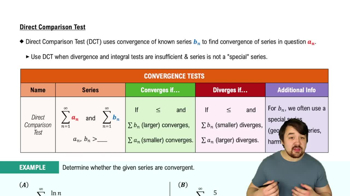
The comparison test involves comparing a given series to a known benchmark series to determine convergence or divergence. If the terms of the given series are smaller than those of a convergent series, it also converges; if larger than a divergent series, it diverges.
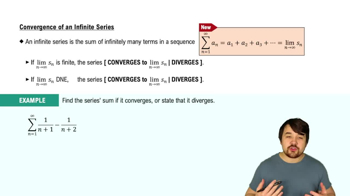
Understanding convergence means determining whether the sum of infinitely many terms approaches a finite limit. Tests like the p-series test and comparison test help decide if the infinite sum converges or diverges, which is crucial for analyzing series behavior.