40–62. Choose your test Use the test of your choice to determine whether the following series converge. ∑ (k = 1 to ∞) k⁸ / (k¹¹ + 3)
Verified step by step guidance
1
Identify the given series: \( \sum_{k=1}^{\infty} \frac{k^{8}}{k^{11} + 3} \). We want to determine whether this series converges or diverges.
Simplify the general term for large \(k\) by comparing the dominant powers in numerator and denominator. For large \(k\), \( k^{11} + 3 \approx k^{11} \), so the term behaves like \( \frac{k^{8}}{k^{11}} = k^{-3} \).
Recognize that the series resembles a \(p\)-series of the form \( \sum k^{-p} \) with \( p = 3 \). Recall that a \(p\)-series converges if and only if \( p > 1 \).
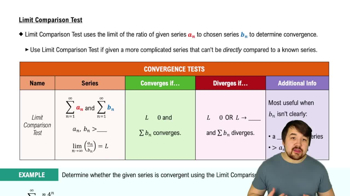
Use the Limit Comparison Test with the series \( \sum \frac{1}{k^{3}} \) to rigorously confirm convergence. Compute the limit \( L = \lim_{k \to \infty} \frac{\frac{k^{8}}{k^{11} + 3}}{\frac{1}{k^{3}}} \).
Evaluate the limit \(L\). If \( 0 < L < \infty \), then both series either converge or diverge together. Since \( \sum \frac{1}{k^{3}} \) converges, conclude that the original series converges.
Verified video answer for a similar problem:
This video solution was recommended by our tutors as helpful for the problem above
Video duration:
3m
Play a video:
0 Comments
Key Concepts
Here are the essential concepts you must grasp in order to answer the question correctly.
Convergence of Infinite Series
An infinite series converges if the sum of its terms approaches a finite limit as the number of terms grows indefinitely. Determining convergence involves analyzing the behavior of the terms and applying appropriate tests to see if the series sums to a finite value.
These tests compare the given series to a known benchmark series. The Comparison Test checks if terms are smaller or larger than a convergent or divergent series, while the Limit Comparison Test uses the limit of the ratio of terms to determine convergence by comparing growth rates.
Understanding how the terms behave for large indices (k → ∞) helps simplify the series. For example, in k⁸ / (k¹¹ + 3), the dominant term in the denominator is k¹¹, so the term behaves like k⁸/k¹¹ = 1/k³, which guides the choice of comparison series.