79–82. {Use of Tech} Double table look-up The following integrals may require more than one table look-up. Evaluate the integrals using a table of integrals, and then check your answer with a computer algebra system. 79. ∫ x sin⁻¹(2x) dx
Verified step by step guidance
1
Identify the integral to solve: \(\int x \sin^{-1}(2x) \, dx\). Notice that it is a product of two functions: \(x\) and \(\sin^{-1}(2x)\), which suggests using integration by parts.
Recall the integration by parts formula: \(\int u \, dv = uv - \int v \, du\). Choose \(u\) and \(dv\) wisely. Let \(u = \sin^{-1}(2x)\) because its derivative simplifies, and let \(dv = x \, dx\).
Compute \(du\) by differentiating \(u\): Use the chain rule for \(\sin^{-1}(2x)\), so \(du = \frac{2}{\sqrt{1 - (2x)^2}} \, dx = \frac{2}{\sqrt{1 - 4x^2}} \, dx\). Compute \(v\) by integrating \(dv\): \(v = \int x \, dx = \frac{x^2}{2}\).
Apply the integration by parts formula: \(\int x \sin^{-1}(2x) \, dx = u v - \int v \, du = \sin^{-1}(2x) \cdot \frac{x^2}{2} - \int \frac{x^2}{2} \cdot \frac{2}{\sqrt{1 - 4x^2}} \, dx\).
Simplify the integral: The integral becomes \(\int \frac{x^2}{\sqrt{1 - 4x^2}} \, dx\). This integral may require a substitution or a second table look-up. Consider substituting \(t = 2x\) or using a trigonometric substitution to evaluate it.
Verified video answer for a similar problem:
This video solution was recommended by our tutors as helpful for the problem above
Video duration:
8m
Play a video:
0 Comments
Key Concepts
Here are the essential concepts you must grasp in order to answer the question correctly.
Integration by Parts
Integration by parts is a technique used to integrate products of functions. It is based on the product rule for differentiation and is expressed as ∫u dv = uv - ∫v du. Choosing appropriate u and dv simplifies the integral, especially when one function becomes simpler upon differentiation.
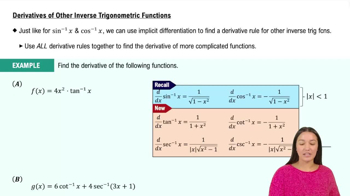
Inverse trigonometric functions, like sin⁻¹(x), are the inverses of trigonometric functions and have specific derivatives and integrals. Understanding their properties and derivatives, such as d/dx[sin⁻¹(x)] = 1/√(1 - x²), is essential for integrating expressions involving these functions.
Derivatives of Other Inverse Trigonometric Functions
Use of Integral Tables and Computer Algebra Systems
Integral tables provide standard forms of integrals that can be referenced to solve complex integrals efficiently. Computer algebra systems (CAS) can verify solutions and handle complicated integrals, ensuring accuracy and saving time during problem-solving.

 8:16 minutes
 Verified step by step guidance
 06:18
06:18