In Exercises 3–8, find the limit of each function (a) as x → ∞ and (b) as x → −∞. (You may wish to visualize your answer with a graphing calculator or computer.)
g(x) = 1/(2 + (1/x))
Verified step by step guidance
1
Step 1: Understand the function g(x) = 1/(2 + (1/x)). As x approaches infinity or negative infinity, the behavior of the function is influenced by the term (1/x).
Step 2: Consider the limit as x approaches infinity (x → ∞). As x becomes very large, the term (1/x) approaches 0. Therefore, the expression inside the denominator becomes 2 + 0 = 2.
Step 3: Simplify the function for x → ∞. The function g(x) simplifies to 1/2 when x is very large, since the (1/x) term becomes negligible.
Step 4: Now consider the limit as x approaches negative infinity (x → −∞). Similar to the previous case, as x becomes very large in the negative direction, the term (1/x) also approaches 0.
Step 5: Simplify the function for x → −∞. The function g(x) again simplifies to 1/2, as the (1/x) term becomes negligible, leaving the denominator as approximately 2.
Verified video answer for a similar problem:
This video solution was recommended by our tutors as helpful for the problem above
Video duration:
3m
Play a video:
0 Comments
Key Concepts
Here are the essential concepts you must grasp in order to answer the question correctly.
Limits
Limits are fundamental in calculus, representing the value that a function approaches as the input approaches a certain point. They are crucial for understanding the behavior of functions at specific points, including infinity. In this context, we are interested in evaluating the limits of the function g(x) as x approaches both positive and negative infinity.
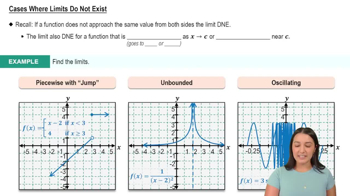
When analyzing limits as x approaches infinity or negative infinity, we focus on the end behavior of the function. This involves determining how the function behaves as the input grows larger or smaller without bound. For rational functions, this often involves simplifying the expression to identify dominant terms that dictate the limit.
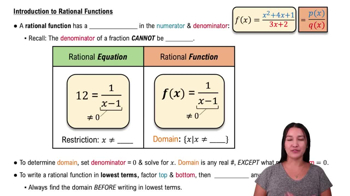
Rational functions are ratios of polynomials, and their limits can often be evaluated by examining the degrees of the numerator and denominator. In the case of g(x) = 1/(2 + (1/x)), as x approaches infinity, the term (1/x) approaches zero, simplifying the function. Understanding how to manipulate and simplify rational functions is key to finding their limits.

 3:50 minutes
 Verified step by step guidance

 05:50
05:50