In Exercises 3–8, find the limit of each function (a) as x → ∞ and (b) as x → −∞. (You may wish to visualize your answer with a graphing calculator or computer.)
h(x) = (−5 + (7/x))/(3 – (1/x²))
Verified step by step guidance
1
Identify the dominant terms in the numerator and the denominator as x approaches infinity. For h(x) = \( \frac{-5 + \frac{7}{x}}{3 - \frac{1}{x^2}} \), the dominant terms are -5 in the numerator and 3 in the denominator.
As x approaches infinity, the terms \( \frac{7}{x} \) and \( \frac{1}{x^2} \) approach zero. Therefore, the expression simplifies to \( \frac{-5}{3} \).
Thus, the limit of h(x) as x approaches infinity is \( \frac{-5}{3} \).
Now, consider the limit as x approaches negative infinity. Again, the terms \( \frac{7}{x} \) and \( \frac{1}{x^2} \) approach zero, simplifying the expression to \( \frac{-5}{3} \).
Therefore, the limit of h(x) as x approaches negative infinity is also \( \frac{-5}{3} \).
Verified video answer for a similar problem:
This video solution was recommended by our tutors as helpful for the problem above
Video duration:
3m
Play a video:
0 Comments
Key Concepts
Here are the essential concepts you must grasp in order to answer the question correctly.
Limits at Infinity
Limits at infinity involve determining the behavior of a function as the input approaches positive or negative infinity. This concept helps in understanding the end behavior of functions, often simplifying expressions by focusing on dominant terms. For rational functions, this typically involves comparing the degrees of the numerator and denominator.
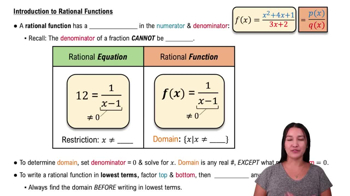
Simplification of rational functions is crucial when finding limits at infinity. It involves identifying and focusing on the dominant terms in the numerator and denominator, as terms with higher powers of x will dictate the behavior of the function as x approaches infinity. This simplification often leads to easier computation of limits.
Graphical visualization aids in understanding the behavior of functions as x approaches infinity or negative infinity. By using graphing tools, one can observe the asymptotic behavior and confirm analytical results. This visual approach complements algebraic methods, providing a clearer picture of the function's end behavior.

 3:35 minutes
 Verified step by step guidance
 03:07
03:07