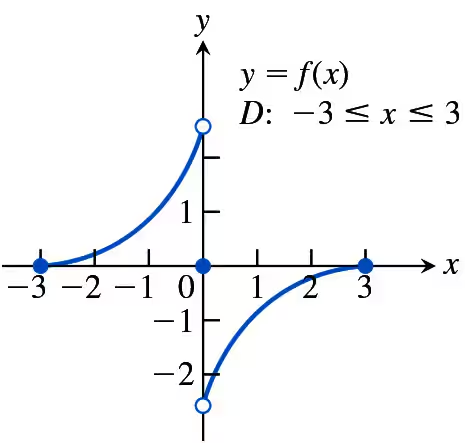
Each figure in Exercises 45–50 shows the graph of a function over a closed interval D. At what domain points does the function appear to be
c. neither continuous nor differentiable?
Give reasons for your answers.
Verified step by step guidance
1
Examine the graph to identify any points where the function is not continuous. A function is not continuous at a point if there is a break, jump, or hole in the graph at that point.
Look for points where the function is not differentiable. A function is not differentiable at a point if there is a sharp corner or cusp, or if the function is not continuous at that point.
In the given graph, observe the open circles at x = -3 and x = 3, indicating that the function is not defined at these endpoints, hence not continuous.
Notice the sharp corner at x = 0, which suggests that the function is not differentiable at this point.
Conclude that the function is neither continuous nor differentiable at x = -3 and x = 3 due to the open circles, and not differentiable at x = 0 due to the sharp corner.
Verified video answer for a similar problem:
This video solution was recommended by our tutors as helpful for the problem above
Video duration:
3m
Play a video:
0 Comments
Key Concepts
Here are the essential concepts you must grasp in order to answer the question correctly.
Continuity
A function is continuous at a point if the limit of the function as it approaches that point equals the function's value at that point. In simpler terms, there should be no breaks, jumps, or holes in the graph at that point. For a function to be continuous over an interval, it must be continuous at every point within that interval.
A function is differentiable at a point if it has a defined derivative at that point, which means the function must be smooth and not have any sharp corners or vertical tangents. If a function is not continuous at a point, it cannot be differentiable there. Thus, differentiability implies continuity, but continuity does not necessarily imply differentiability.
Points of discontinuity occur where a function is not continuous, which can happen due to removable discontinuities (holes), jump discontinuities, or infinite discontinuities (asymptotes). In the provided graph, the open circles at x = -3 and x = 2 indicate points where the function is not defined, suggesting that the function is neither continuous nor differentiable at these points.