Multiple ChoiceGiven the figure showing four curves labeled A, B, C, and D, which represent the functions f(x)=sinx, f′(x), f″(x), and f‴(x), respectively, which curve corresponds to f″(x)?153views
Multiple ChoiceSketch the function y=cos(x)−1y=\(\cos\]\left\)(x\(\right\))-1y=cos(x)−1 on the graph below.339views6rank
Multiple ChoiceDetermine the value of y=sin(−π2)+50y=\(\sin\[\left\)(-\(\frac{\pi}{2}\]\right\))+50y=sin(−2π)+50 without using a calculator or the unit circle.336views8rank
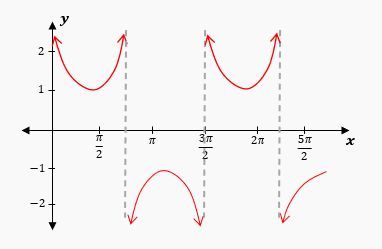
Multiple ChoiceBelow is a graph of the function y=sec(bx−π)y=\(\sec\[\left\)(bx-\(\pi\]\right\))y=sec(bx−π). Determine the value of b.291views2rank
Multiple ChoiceBelow is a graph of the function y=tan(bx)y=\(\tan\]\left\)(bx\(\right\))y=tan(bx). Determine the value of b.432views6rank
Multiple ChoiceBelow is a graph of the function y=cot(bx+π2)y=\(\cot\[\left\)(bx+\(\frac{\pi}{2}\]\right\))y=cot(bx+2π). Determine the value of b.340views3rank
Textbook QuestionIdentify the amplitude and period of the following functions.f(π)=2sin2θf\(\left\)(\(\pi\]\right\))=2\(\sin\)2\(\theta\)f(π)=2sin2θ285views
Textbook QuestionIdentify the amplitude and period of the following functions.g(θ)=3cos(θ3)g\(\left\)(\(\theta\]\right\))=3\(\cos\[\left\)(\(\frac{\theta}{3}\]\right\))g(θ)=3cos(3θ)412views


 Verified step by step guidance

