d. Over what intervals of x-values, if any, does the function y = f(x) increase as x increases? Decrease as x increases? How is this related to what you found in part (c)? (We will say more about this relationship in Section 4.3.)
y = −1/x
Verified step by step guidance
1
To determine where the function y = -1/x is increasing or decreasing, we first need to find its derivative. The derivative, y', will help us understand the behavior of the function.
Calculate the derivative of y = -1/x. Using the power rule, rewrite the function as y = -x^(-1) and differentiate to get y' = x^(-2) = 1/x^2.
Analyze the sign of the derivative y' = 1/x^2. Since 1/x^2 is always positive for all x ≠ 0, the function does not change sign and is always positive.
Since the derivative y' = 1/x^2 is positive for all x ≠ 0, the function y = -1/x is decreasing on its entire domain, which is x < 0 and x > 0.
Relate this to part (c) by considering the critical points and intervals of increase or decrease. Since there are no critical points where the derivative is zero or undefined (other than x = 0, which is not in the domain), the function is decreasing on both intervals x < 0 and x > 0.
Verified video answer for a similar problem:
This video solution was recommended by our tutors as helpful for the problem above
Video duration:
4m
Play a video:
0 Comments
Key Concepts
Here are the essential concepts you must grasp in order to answer the question correctly.
Increasing and Decreasing Functions
A function is increasing on an interval if, for any two numbers x1 and x2 within that interval, x1 < x2 implies f(x1) < f(x2). Conversely, a function is decreasing if x1 < x2 implies f(x1) > f(x2). Understanding these definitions helps determine where the function y = -1/x increases or decreases as x changes.
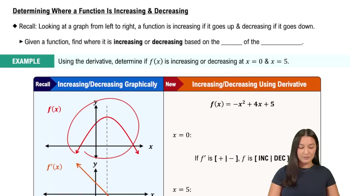
Determining Where a Function is Increasing & Decreasing
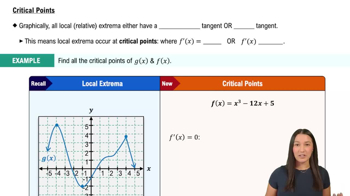
Derivative and Critical Points
The derivative of a function, f'(x), provides information about the function's rate of change. Critical points occur where f'(x) = 0 or is undefined, indicating potential changes in increasing or decreasing behavior. For y = -1/x, the derivative helps identify intervals of increase or decrease by analyzing where the derivative is positive or negative.
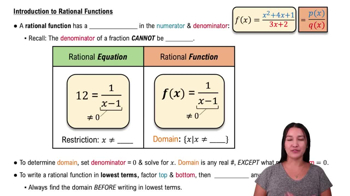
Rational functions, like y = -1/x, have unique behaviors due to their asymptotes and undefined points. Understanding how these functions behave near vertical asymptotes and across different intervals is crucial. For y = -1/x, the function's behavior as x approaches zero from either side is key to determining its increasing or decreasing nature.