37. What value of a makes f(x) = x^2 +(a/x) have a. a local minimum at x = 2? b. a point of inflection at x = 1?
Verified step by step guidance
1
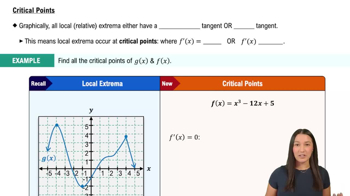
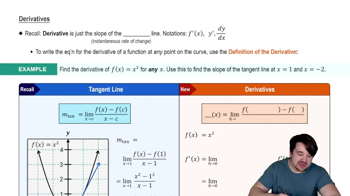
To find the value of 'a' that makes f(x) = x^2 + (a/x) have a local minimum at x = 2, first find the first derivative f'(x) and set it equal to zero to find critical points. The derivative is f'(x) = 2x - a/x^2.
Substitute x = 2 into the derivative equation: 2(2) - a/(2^2) = 0. Solve this equation for 'a' to find the value that makes x = 2 a critical point.
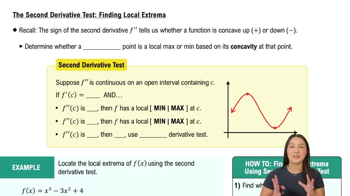
To ensure that x = 2 is a local minimum, check the second derivative f''(x) = 2 + 2a/x^3. Substitute x = 2 and the value of 'a' found in the previous step into f''(x) to verify that f''(2) > 0.
For the point of inflection at x = 1, find the second derivative f''(x) = 2 + 2a/x^3 and set it equal to zero. Substitute x = 1 into the equation: 2 + 2a/(1^3) = 0. Solve this equation for 'a' to find the value that makes x = 1 a point of inflection.
Verify that the sign of f''(x) changes around x = 1 by checking the values of f''(x) just before and after x = 1 with the found value of 'a'. This confirms the point of inflection.
Verified video answer for a similar problem:
This video solution was recommended by our tutors as helpful for the problem above
Video duration:
8m
Play a video:
0 Comments
Key Concepts
Here are the essential concepts you must grasp in order to answer the question correctly.
Local Minimum
A local minimum of a function occurs at a point where the function value is lower than at nearby points. To find a local minimum, we use the first derivative test: set the derivative equal to zero to find critical points, and then use the second derivative to determine if the point is a minimum (second derivative > 0) or maximum (second derivative < 0).
A point of inflection is where the function changes concavity, from concave up to concave down or vice versa. It is identified by setting the second derivative equal to zero and confirming a change in sign around the point. This indicates a transition in the curvature of the graph, but not necessarily a local extremum.
Calculating derivatives is essential for analyzing the behavior of functions. The first derivative, f'(x), provides information on the slope and critical points, while the second derivative, f''(x), helps determine concavity and points of inflection. For f(x) = x^2 + (a/x), apply differentiation rules to find these derivatives and solve for the conditions given in the problem.