Suppose that a function f(x) is defined for all x in [-1,1]. Can anything be said about the existence of limx→0 f(x)? Give reasons for your answer.
Verified step by step guidance
1
Consider the definition of a limit: lim(x→c) f(x) exists if f(x) approaches a specific value L as x approaches c from both sides.
Since f(x) is defined for all x in the interval [-1, 1], it means f(x) is defined at x = 0 and in the neighborhood around x = 0.
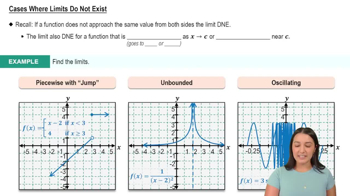
For the limit lim(x→0) f(x) to exist, the left-hand limit (as x approaches 0 from the left) and the right-hand limit (as x approaches 0 from the right) must both exist and be equal.
However, the problem does not provide any information about the behavior of f(x) near x = 0, such as continuity or specific values, so we cannot definitively conclude whether the limit exists.
Without additional information about the behavior of f(x) near x = 0, such as continuity or specific functional values, we cannot determine the existence of lim(x→0) f(x).
Verified video answer for a similar problem:
This video solution was recommended by our tutors as helpful for the problem above
Video duration:
4m
Play a video:
0 Comments
Key Concepts
Here are the essential concepts you must grasp in order to answer the question correctly.
Limit of a Function
The limit of a function describes the behavior of the function as the input approaches a particular value. In this case, we are interested in the limit as x approaches 0. A limit exists if the function approaches a specific value from both the left and right sides of that point.
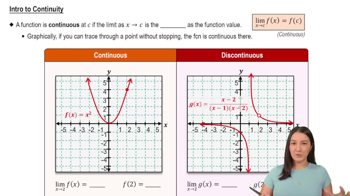
A function is continuous at a point if the limit of the function as it approaches that point equals the function's value at that point. If f(x) is continuous at x = 0, then limx→0 f(x) = f(0). Understanding continuity helps determine if the limit exists based on the function's behavior around that point.
The existence of a limit is not guaranteed just because a function is defined in an interval. For limx→0 f(x) to exist, the left-hand limit and right-hand limit as x approaches 0 must be equal. If the function has any discontinuities or undefined behavior at or around x = 0, it may affect the existence of the limit.