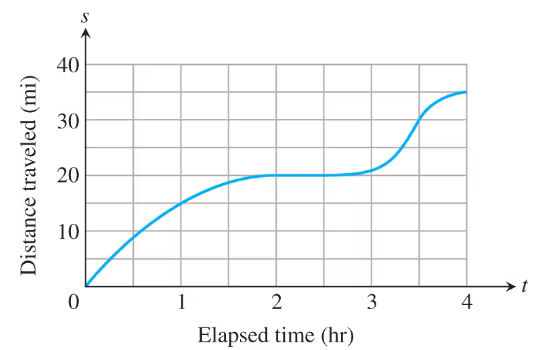
The accompanying graph shows the total distance s traveled by a bicyclist after t hours. b. Estimate the bicyclist’s instantaneous speed at the times t=1/2, t=2, and t=3.
Verified step by step guidance
1
To estimate the bicyclist's instantaneous speed at a given time, we need to find the derivative of the distance function s with respect to time t, which represents the speed. This is done by calculating the slope of the tangent line to the curve at the specified time.
For t = 1/2, identify the point on the graph where t = 1/2 and draw a tangent line at this point. Estimate the slope of this tangent line by choosing two points on the tangent line and using the formula for slope: \( \text{slope} = \frac{\Delta s}{\Delta t} \).
Repeat the process for t = 2. Locate the point on the graph where t = 2, draw the tangent line, and estimate its slope using two points on the tangent line.
Similarly, for t = 3, find the point on the graph where t = 3, draw the tangent line, and estimate the slope using two points on the tangent line.
The estimated slopes at t = 1/2, t = 2, and t = 3 will give you the bicyclist's instantaneous speeds at these times. Remember, the slope of the tangent line at a point on the graph of a function is the derivative of the function at that point, which represents the instantaneous rate of change.
Verified video answer for a similar problem:
This video solution was recommended by our tutors as helpful for the problem above
Video duration:
2m
Play a video:
0 Comments
Key Concepts
Here are the essential concepts you must grasp in order to answer the question correctly.
Instantaneous Speed
Instantaneous speed refers to the speed of an object at a specific moment in time. In calculus, it is determined by finding the derivative of the position function with respect to time. This derivative gives the rate of change of distance with respect to time, allowing us to calculate how fast the bicyclist is moving at particular instances.
The derivative is a fundamental concept in calculus that measures how a function changes as its input changes. It represents the slope of the tangent line to the graph of the function at a given point. In the context of the bicyclist's distance function, the derivative at a specific time gives the instantaneous speed at that moment.
Interpreting graphs is crucial in calculus as it allows us to visualize relationships between variables. In this case, the graph of total distance versus time helps us understand how the bicyclist's speed changes over time. By analyzing the slope of the graph at specific points, we can estimate the instantaneous speed at those times.