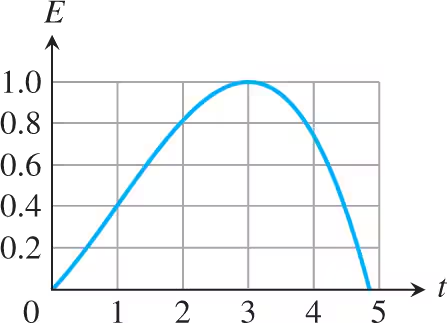
Effectiveness of a drug On a scale from 0 to 1, the effectiveness E of a pain-killing drug t hours after entering the bloodstream is displayed in the accompanying figure.
a. At what times does the effectiveness appear to be increasing? What is true about the derivative at those times?
Verified step by step guidance
1
Step 1: Observe the graph of the effectiveness E versus time t. The effectiveness E increases from t = 0 to t = 3, as the curve slopes upward during this interval.
Step 2: Recall that the derivative of a function represents the rate of change of the function. When the effectiveness E is increasing, the derivative dE/dt is positive.
Step 3: Identify the interval where the slope of the graph is positive. From the graph, the slope is positive from t = 0 to t = 3, indicating that the derivative dE/dt > 0 during this interval.
Step 4: Note that at t = 3, the graph reaches its maximum point, where the slope becomes zero. This means the derivative dE/dt = 0 at t = 3.
Step 5: Conclude that the effectiveness appears to be increasing during the interval 0 < t < 3, and the derivative is positive during this time.
Verified video answer for a similar problem:
This video solution was recommended by our tutors as helpful for the problem above
Video duration:
2m
Play a video:
0 Comments
Key Concepts
Here are the essential concepts you must grasp in order to answer the question correctly.
Derivative and Increasing Function
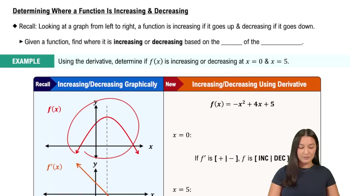
The derivative of a function at a point gives the slope of the tangent line at that point. If the derivative is positive over an interval, the function is increasing on that interval. In the context of the drug's effectiveness, the derivative E'(t) is positive when the effectiveness is increasing, which can be observed from the graph where the slope is upward.
Determining Where a Function is Increasing & Decreasing
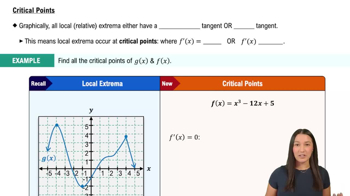
Critical Points and Maximum Effectiveness
Critical points occur where the derivative is zero or undefined, often indicating potential maxima or minima. In the graph, the effectiveness reaches a maximum when the derivative changes from positive to negative, which is around t = 3 hours. This is where the drug's effectiveness is at its peak before it starts to decrease.
Understanding how to interpret graphs is crucial in calculus. The graph of E(t) shows the effectiveness of the drug over time. By analyzing the slope of the graph, one can determine intervals of increase or decrease. The graph indicates that the effectiveness increases from t = 0 to t = 3 and decreases thereafter, which aligns with the derivative's behavior.