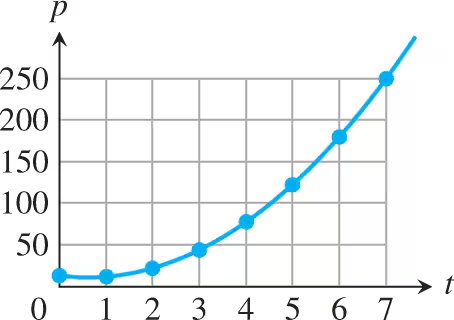
Growth of yeast cells In a controlled laboratory experiment, yeast cells are grown in an automated cell culture system that counts the number P of cells present at hourly intervals. The number after t hours is shown in the accompanying figure.
a. Explain what is meant by the derivative P'(5). What are its units?
Verified step by step guidance
1
Step 1: Understand the meaning of the derivative P'(t). The derivative P'(t) represents the rate of change of the number of yeast cells (P) with respect to time (t). In simpler terms, it tells us how quickly the population of yeast cells is growing at a specific time.
Step 2: Interpret P'(5). Specifically, P'(5) refers to the rate of change of the yeast cell population at t = 5 hours. It provides the instantaneous growth rate of the yeast cells at that moment in time.
Step 3: Determine the units of P'(5). Since P represents the number of yeast cells and t represents time in hours, the derivative P'(t) will have units of 'cells per hour.' This is because it measures the change in the number of cells (P) per unit of time (t).
Step 4: Relate P'(5) to the graph. To estimate P'(5) from the graph, you would examine the slope of the tangent line to the curve at t = 5. The steeper the slope, the faster the growth rate at that time.
Step 5: Explain the significance of P'(5). The value of P'(5) is important in understanding the dynamics of yeast cell growth. It helps researchers determine how quickly the population is expanding at a specific point in the experiment, which can be useful for optimizing growth conditions or predicting future population sizes.
Verified video answer for a similar problem:

This video solution was recommended by our tutors as helpful for the problem above
Video duration:
2m
Play a video:
0 Comments
Key Concepts
Here are the essential concepts you must grasp in order to answer the question correctly.
Derivative
The derivative of a function at a given point measures the rate at which the function's value changes as its input changes. In the context of the yeast cell growth, P'(5) represents the rate of change of the number of yeast cells at t = 5 hours. It provides insight into how quickly the cell population is increasing at that specific time.
The units of a derivative are determined by the units of the function and its input. For P'(5), the function P(t) represents the number of yeast cells, and t is measured in hours. Therefore, the units of P'(5) are cells per hour, indicating the rate of change in the number of cells with respect to time.
Evaluate Composite Functions - Values on Unit Circle
Interpreting Graphs
Interpreting graphs involves understanding the relationship between variables depicted visually. The graph shows the number of yeast cells over time, with the slope at any point indicating the rate of growth. At t = 5, the steepness of the curve suggests a rapid increase in cell count, which is quantified by the derivative P'(5).