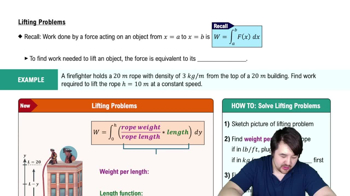
Explain why or why not Determine whether the following statements are true and give an explanation or counterexample. c. The work required to lift a 10-kg object vertically 10 m is the same as the work required to lift a 20-kg object vertically 5 m.
Verified step by step guidance
1
Recall the formula for work done against gravity when lifting an object vertically: \(W = m \cdot g \cdot h\), where \(m\) is the mass of the object, \(g\) is the acceleration due to gravity (approximately \(9.8\, m/s^2\)), and \(h\) is the height the object is lifted.
Calculate the work done to lift the 10-kg object 10 meters: \(W_1 = 10 \cdot g \cdot 10\).
Calculate the work done to lift the 20-kg object 5 meters: \(W_2 = 20 \cdot g \cdot 5\).
Compare \(W_1\) and \(W_2\) by simplifying both expressions to see if they are equal or not.
Conclude whether the statement is true or false based on the comparison, and explain that work depends on both mass and height, so equal work means the product \(m \cdot h\) must be the same.
Verified video answer for a similar problem:
This video solution was recommended by our tutors as helpful for the problem above
Video duration:
2m
Play a video:
0 Comments
Key Concepts
Here are the essential concepts you must grasp in order to answer the question correctly.
Work Done by a Force
Work is defined as the product of the force applied to an object and the displacement in the direction of the force. Mathematically, work = force × distance × cos(θ). For lifting vertically, the force equals the weight of the object, and displacement is the vertical height moved.
Weight is the gravitational force acting on an object and is calculated as mass times gravitational acceleration (W = mg). Different masses result in different weights, which directly affect the amount of work needed to lift the object.
To compare work done lifting different masses over different heights, multiply each mass by gravitational acceleration and the height lifted. If the products are equal, the work done is the same; otherwise, it differs. This helps determine if lifting a heavier object a shorter distance equals lifting a lighter object a longer distance.