42–76. Convergence or divergence Use a convergence test of your choice to determine whether the following series converge. ∑ (from k = 1 to ∞)k⁵ e⁻ᵏ
Verified step by step guidance
1
Identify the series given: \( \sum_{k=1}^{\infty} k^{5} e^{-k} \). This is an infinite series where the general term is \( a_k = k^{5} e^{-k} \).
Recognize that the term \( e^{-k} \) can be rewritten as \( \left( \frac{1}{e} \right)^k \), which is an exponential decay factor.
Consider using the Ratio Test for convergence, which is effective for series involving factorials, exponentials, or powers. The Ratio Test states to compute \( L = \lim_{k \to \infty} \left| \frac{a_{k+1}}{a_k} \right| \).
Calculate the ratio \( \frac{a_{k+1}}{a_k} = \frac{(k+1)^5 e^{-(k+1)}}{k^5 e^{-k}} = \frac{(k+1)^5}{k^5} \cdot e^{-1} \). Simplify this expression to prepare for taking the limit as \( k \to \infty \).
Evaluate the limit \( L = \lim_{k \to \infty} \frac{(k+1)^5}{k^5} \cdot e^{-1} \). Since \( \frac{(k+1)^5}{k^5} \to 1 \), the limit simplifies to \( L = e^{-1} \). Use the Ratio Test conclusion: if \( L < 1 \), the series converges; if \( L > 1 \), it diverges; if \( L = 1 \), the test is inconclusive.
Verified video answer for a similar problem:
This video solution was recommended by our tutors as helpful for the problem above
Video duration:
4m
Play a video:
0 Comments
Key Concepts
Here are the essential concepts you must grasp in order to answer the question correctly.
Infinite Series and Convergence
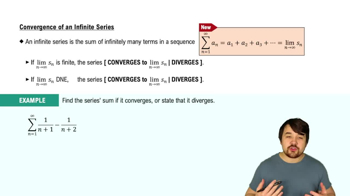
An infinite series is the sum of infinitely many terms. Determining whether such a series converges means checking if the sum approaches a finite limit as the number of terms grows indefinitely. Understanding convergence is essential to analyze the behavior of series like ∑ k⁵ e⁻ᵏ.
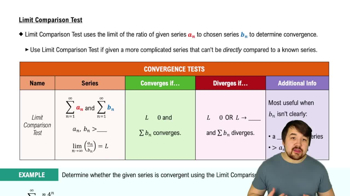
These tests help determine convergence by comparing the given series to a known benchmark series. The Comparison Test checks if terms are smaller than those of a convergent series, while the Limit Comparison Test uses the limit of the ratio of terms. They are useful when terms involve products like polynomial and exponential functions.
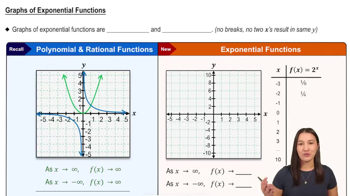
Exponential functions like e⁻ᵏ decay faster than any polynomial grows as k approaches infinity. This means terms like k⁵ e⁻ᵏ tend to zero rapidly, often ensuring convergence of the series. Recognizing this interplay helps in selecting appropriate convergence tests.