42–76. Convergence or divergence Use a convergence test of your choice to determine whether the following series converge. ∑ (from k = 1 to ∞)3 / (2 + eᵏ)
Verified step by step guidance
1
Identify the series given: \( \sum_{k=1}^{\infty} \frac{3}{2 + e^{k}} \). We want to determine if this infinite series converges or diverges.
Observe the general term of the series: \( a_k = \frac{3}{2 + e^{k}} \). Since \( e^{k} \) grows exponentially, the denominator increases very quickly as \( k \) becomes large.
Compare \( a_k \) to a simpler series to test for convergence. Notice that for large \( k \), \( 2 + e^{k} \approx e^{k} \), so \( a_k \approx \frac{3}{e^{k}} \). This suggests comparing to the geometric series \( \sum \frac{3}{e^{k}} \).
Recall that a geometric series \( \sum r^{k} \) converges if \( |r| < 1 \). Here, \( r = \frac{1}{e} \), which is less than 1, so \( \sum \frac{3}{e^{k}} \) converges.
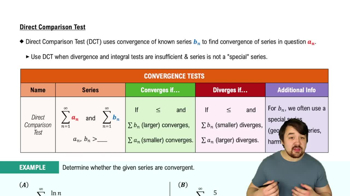
By the Comparison Test, since \( 0 < \frac{3}{2 + e^{k}} < \frac{3}{e^{k}} \) for all \( k \) and \( \sum \frac{3}{e^{k}} \) converges, the original series \( \sum_{k=1}^{\infty} \frac{3}{2 + e^{k}} \) also converges.
Verified video answer for a similar problem:
This video solution was recommended by our tutors as helpful for the problem above
Video duration:
4m
Play a video:
0 Comments
Key Concepts
Here are the essential concepts you must grasp in order to answer the question correctly.
Infinite Series and Convergence
An infinite series is the sum of infinitely many terms. Understanding whether such a series converges (approaches a finite limit) or diverges (grows without bound or oscillates) is fundamental in calculus. Convergence ensures the series has a meaningful sum.
The Comparison Test determines convergence by comparing the given series to a second series with known behavior. If the terms of the given series are smaller than those of a convergent series, it also converges; if larger than a divergent series, it diverges.
Exponential functions like e^k grow very rapidly as k increases. In the series terms 3/(2 + e^k), the denominator grows exponentially, causing terms to approach zero quickly, which is a key factor in assessing convergence.