Find d/dx (In(xe^x)) without using the Chain Rule and the Product Rule.
Verified step by step guidance
1
Step 1: Begin by recognizing that the expression inside the logarithm is a product: \(xe^x\). We can use the property of logarithms that \(\ln(a \cdot b) = \ln(a) + \ln(b)\). Apply this property to rewrite the expression as \(\ln(x) + \ln(e^x)\).
Step 2: Simplify \(\ln(e^x)\). Recall that \(\ln(e^x) = x \cdot \ln(e)\), and since \(\ln(e) = 1\), this simplifies to \(x\). Therefore, the expression becomes \(\ln(x) + x\).
Step 3: Differentiate \(\ln(x)\) with respect to \(x\). The derivative of \(\ln(x)\) is \(\frac{1}{x}\).
Step 4: Differentiate \(x\) with respect to \(x\). The derivative of \(x\) is simply \(1\).
Step 5: Combine the derivatives from Step 3 and Step 4. The derivative of \(\ln(x) + x\) is \(\frac{1}{x} + 1\).
Verified video answer for a similar problem:
This video solution was recommended by our tutors as helpful for the problem above
Video duration:
4m
Play a video:
0 Comments
Key Concepts
Here are the essential concepts you must grasp in order to answer the question correctly.
Natural Logarithm Properties
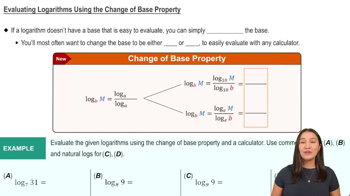
Understanding the properties of natural logarithms is essential for simplifying expressions involving ln. Specifically, the property ln(a*b) = ln(a) + ln(b) allows us to break down the logarithm of a product into a sum, which can simplify differentiation.
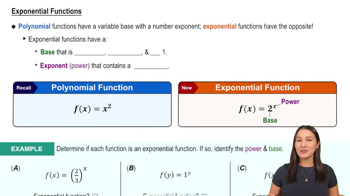
Exponential functions, such as e^x, have unique properties that make them easier to differentiate. The derivative of e^x is e^x itself, which simplifies calculations significantly when combined with logarithmic functions.
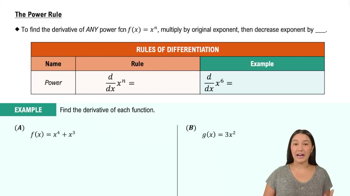
Familiarity with basic differentiation rules, such as the derivative of a constant and the power rule, is crucial. These rules provide the foundation for finding derivatives without relying on more complex techniques like the Chain Rule or Product Rule.