Find and simplify the derivative of the following functions. f(x) = √(e2x + 8x2ex +16x4) (Hint: Factor the function under the square root first.)
Verified step by step guidance
1
Step 1: Recognize that the function f(x) = \(\sqrt{e^{2x}\) + 8x^2e^x + 16x^4} is a composition of functions, where the outer function is the square root and the inner function is a polynomial expression. To simplify the differentiation process, factor the expression under the square root.
Step 2: Notice that the expression under the square root, e^{2x} + 8x^2e^x + 16x^4, can be factored. Look for a common factor or a pattern that resembles a perfect square trinomial. In this case, it can be factored as (e^x + 4x^2)^2.
Step 3: Substitute the factored form back into the original function: f(x) = \(\sqrt{(e^x + 4x^2)^2}\). The square root and the square cancel each other out, simplifying the function to f(x) = e^x + 4x^2.
Step 4: Differentiate the simplified function f(x) = e^x + 4x^2. Use the sum rule of differentiation, which states that the derivative of a sum is the sum of the derivatives. Differentiate each term separately: the derivative of e^x is e^x, and the derivative of 4x^2 is 8x.
Step 5: Combine the derivatives of each term to find the derivative of the entire function: f'(x) = e^x + 8x. This is the simplified derivative of the original function.
Verified video answer for a similar problem:

This video solution was recommended by our tutors as helpful for the problem above
Video duration:
4m
Play a video:
0 Comments
Key Concepts
Here are the essential concepts you must grasp in order to answer the question correctly.
Derivative
The derivative of a function measures how the function's output value changes as its input value changes. It is a fundamental concept in calculus, representing the slope of the tangent line to the function's graph at any given point. Derivatives can be computed using various rules, such as the power rule, product rule, and chain rule, depending on the form of the function.
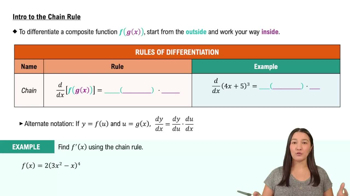
The chain rule is a formula for computing the derivative of a composite function. If a function is composed of two functions, say f(g(x)), the chain rule states that the derivative is the derivative of the outer function evaluated at the inner function multiplied by the derivative of the inner function. This rule is essential when dealing with functions that involve compositions, such as those with square roots or exponentials.
Factoring is the process of breaking down an expression into simpler components, or factors, that can be multiplied together to obtain the original expression. In the context of derivatives, factoring can simplify the function under the square root, making it easier to differentiate. This technique is particularly useful for polynomial expressions, as it can reveal common terms and simplify calculations.