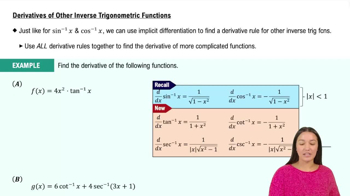
On what interval is the formula d/dx (tanh⁻¹ x) = 1/(1 - x²) valid?
Verified step by step guidance
1
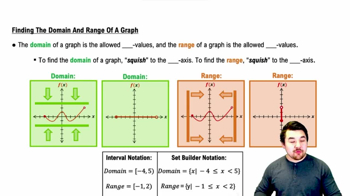
Step 1: Recall the domain of the inverse hyperbolic tangent function, tanh⁻¹(x). The function tanh⁻¹(x) is defined for values of x in the interval (-1, 1), as the hyperbolic tangent function tanh(x) maps the real numbers to the interval (-1, 1).
Step 2: Analyze the derivative formula d/dx (tanh⁻¹ x) = 1/(1 - x²). For this formula to be valid, the denominator (1 - x²) must not be zero, as division by zero is undefined.
Step 3: Solve the inequality 1 - x² ≠ 0 to determine where the formula is valid. This simplifies to x² ≠ 1, which means x ≠ ±1.
Step 4: Combine the domain of tanh⁻¹(x) and the restriction from the derivative formula. The domain of tanh⁻¹(x) is (-1, 1), and the derivative formula is valid as long as x ≠ ±1. Since ±1 are already excluded from the domain of tanh⁻¹(x), the formula is valid on the entire interval (-1, 1).
Step 5: Conclude that the interval on which the formula d/dx (tanh⁻¹ x) = 1/(1 - x²) is valid is (-1, 1).
Verified video answer for a similar problem:
This video solution was recommended by our tutors as helpful for the problem above
Video duration:
1m
Play a video:
0 Comments
Key Concepts
Here are the essential concepts you must grasp in order to answer the question correctly.
Inverse Hyperbolic Functions
The inverse hyperbolic function tanh⁻¹ x, also known as the hyperbolic arctangent, is defined as the inverse of the hyperbolic tangent function. It is used to find the value of x such that tanh(y) = x. Understanding its domain and range is crucial for determining where its derivative is valid.
The derivative of an inverse function can be found using the formula d/dx (f⁻¹(x)) = 1/(f'(f⁻¹(x))). For tanh⁻¹ x, the derivative is given as 1/(1 - x²). This relationship highlights how the behavior of the original function influences the derivative of its inverse.
Derivatives of Other Inverse Trigonometric Functions
Domain of the Derivative
The expression 1/(1 - x²) is valid as long as the denominator is not zero, which occurs when x² = 1. Therefore, the derivative is defined for all x except x = 1 and x = -1. This means the interval of validity for the derivative of tanh⁻¹ x is (-1, 1), where the function remains continuous and differentiable.

 1:55 minutes
 Verified step by step guidance
 5:50
5:50