7–28. Derivatives Evaluate the following derivatives.
d/dx (ln³(3x² + 2))
Verified step by step guidance
1
Step 1: Recognize that the given function is a composite function, specifically the cube of a natural logarithm. Rewrite the function as \( \ln^3(3x^2 + 2) \), which is equivalent to \( [\ln(3x^2 + 2)]^3 \).
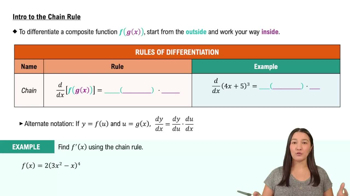
Step 2: Apply the chain rule to differentiate \( [\ln(3x^2 + 2)]^3 \). The chain rule states that \( \frac{d}{dx}[f(g(x))] = f'(g(x)) \cdot g'(x) \). Here, \( f(u) = u^3 \) and \( g(x) = \ln(3x^2 + 2) \).
Step 3: Differentiate the outer function \( u^3 \) with respect to \( u \). This gives \( 3u^2 \), so the derivative of the outer function is \( 3[\ln(3x^2 + 2)]^2 \).
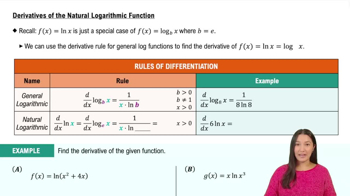
Step 4: Now differentiate the inner function \( \ln(3x^2 + 2) \) with respect to \( x \). The derivative of \( \ln(v) \) is \( \frac{1}{v} \cdot v' \), where \( v = 3x^2 + 2 \). Thus, the derivative is \( \frac{1}{3x^2 + 2} \cdot 6x \).
Step 5: Combine the results from Steps 3 and 4. Multiply \( 3[\ln(3x^2 + 2)]^2 \) by \( \frac{6x}{3x^2 + 2} \) to obtain the final derivative expression.
Verified video answer for a similar problem:
This video solution was recommended by our tutors as helpful for the problem above
Video duration:
3m
Play a video:
0 Comments
Key Concepts
Here are the essential concepts you must grasp in order to answer the question correctly.
Derivatives
A derivative represents the rate of change of a function with respect to a variable. It is a fundamental concept in calculus that allows us to determine how a function behaves as its input changes. The derivative is often denoted as f'(x) or dy/dx, and it can be calculated using various rules, such as the power rule, product rule, and chain rule.
The chain rule is a formula for computing the derivative of a composite function. If a function y is defined as a composition of two functions, say y = f(g(x)), the chain rule states that the derivative dy/dx is the product of the derivative of the outer function f with respect to g and the derivative of the inner function g with respect to x. This is essential for differentiating functions like ln³(3x² + 2).
The natural logarithm, denoted as ln(x), is the logarithm to the base e, where e is approximately 2.71828. It is a key function in calculus, particularly in differentiation and integration. The derivative of ln(x) is 1/x, and when dealing with composite functions involving ln, understanding its properties is crucial for applying the chain rule effectively.

 3:26 minutes
 Verified step by step guidance

 05:44
05:44