Find the derivatives of the functions in Exercises 19–40.
y = (1 / 18)(3x − 2)⁶ + (4 − (1 / 2x²))⁻¹
Verified step by step guidance
1
Identify the two main components of the function: the first term \( \frac{1}{18}(3x - 2)^6 \) and the second term \( \left(4 - \frac{1}{2x^2}\right)^{-1} \). We will differentiate each term separately and then combine the results.
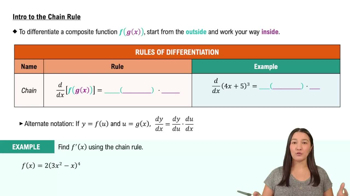
For the first term \( \frac{1}{18}(3x - 2)^6 \), apply the chain rule. The chain rule states that if you have a composite function \( f(g(x)) \), the derivative is \( f'(g(x)) \cdot g'(x) \). Here, let \( u = 3x - 2 \), so the derivative of \( u^6 \) is \( 6u^5 \), and the derivative of \( u \) is \( 3 \). Therefore, the derivative of the first term is \( \frac{1}{18} \cdot 6(3x - 2)^5 \cdot 3 \).
For the second term \( \left(4 - \frac{1}{2x^2}\right)^{-1} \), use the chain rule and the power rule. Let \( v = 4 - \frac{1}{2x^2} \), so the derivative of \( v^{-1} \) is \( -v^{-2} \). The derivative of \( v \) is \( \frac{d}{dx}(4 - \frac{1}{2x^2}) = \frac{d}{dx}(4) - \frac{d}{dx}(\frac{1}{2x^2}) \). The derivative of \( 4 \) is \( 0 \), and the derivative of \( \frac{1}{2x^2} \) is \( -\frac{1}{x^3} \). Therefore, the derivative of \( v \) is \( \frac{1}{x^3} \).
Combine the derivatives of the two terms. The derivative of the first term is \( \frac{1}{18} \cdot 18(3x - 2)^5 \), and the derivative of the second term is \( -\left(4 - \frac{1}{2x^2}\right)^{-2} \cdot \frac{1}{x^3} \).
Add the derivatives of the two terms to find the derivative of the entire function: \( \frac{1}{18} \cdot 18(3x - 2)^5 + \left(-\left(4 - \frac{1}{2x^2}\right)^{-2} \cdot \frac{1}{x^3}\right) \). Simplify the expression if necessary.
Verified video answer for a similar problem:
This video solution was recommended by our tutors as helpful for the problem above
Video duration:
6m
Play a video:
0 Comments
Key Concepts
Here are the essential concepts you must grasp in order to answer the question correctly.
Power Rule
The power rule is a basic derivative rule used to find the derivative of a function in the form of x^n, where n is a constant. It states that the derivative of x^n is n*x^(n-1). This rule is essential for differentiating terms like (3x − 2)⁶ in the given function.
The chain rule is used to differentiate composite functions, where one function is nested inside another. It states that the derivative of f(g(x)) is f'(g(x))*g'(x). This rule is crucial for differentiating the term (3x − 2)⁶, as it involves an inner function (3x − 2) and an outer function raised to the sixth power.
To find the derivative of a reciprocal function like (4 − (1 / 2x²))⁻¹, we use the formula for differentiating 1/u, which is -u'/u². This concept helps in understanding how to differentiate functions that involve division or reciprocal terms, which is necessary for the second part of the given function.

 6:16 minutes
 Verified step by step guidance
 5:50
5:50