Assume that f'(3) = −1, g'(2) = 5, g(2) = 3, and y = f(g(x)). What is y' at x = 2?
Verified step by step guidance
1
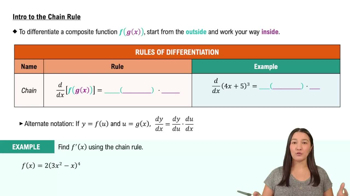
To find y' at x = 2, we need to use the chain rule for differentiation. The chain rule states that if y = f(g(x)), then y' = f'(g(x)) * g'(x).
First, identify the values given in the problem: f'(3) = -1, g'(2) = 5, and g(2) = 3.
Since y = f(g(x)), we need to evaluate g(x) at x = 2. We are given that g(2) = 3, so g(x) at x = 2 is 3.
Next, substitute g(x) = 3 into f'(g(x)). We know f'(3) = -1, so f'(g(x)) at x = 2 is -1.
Finally, apply the chain rule: y' = f'(g(x)) * g'(x). Substitute the values: y' = -1 * 5. Calculate this product to find y' at x = 2.
Verified video answer for a similar problem:
This video solution was recommended by our tutors as helpful for the problem above
Video duration:
2m
Play a video:
0 Comments
Key Concepts
Here are the essential concepts you must grasp in order to answer the question correctly.
Chain Rule
The chain rule is a fundamental theorem in calculus used to differentiate composite functions. If y = f(g(x)), then the derivative y' is found by multiplying the derivative of the outer function f at g(x) by the derivative of the inner function g at x. This allows us to compute the rate of change of y with respect to x when y is a function of another function.
Derivative evaluation involves calculating the derivative of a function at a specific point. In this context, it requires substituting the given values into the derivative formula obtained from applying the chain rule. For y = f(g(x)), y' at x = 2 is calculated using f'(g(2)) and g'(2), which are provided in the problem statement.
A composite function is formed when one function is applied to the result of another function, denoted as y = f(g(x)). Understanding composite functions is crucial for applying the chain rule, as it involves differentiating the outer function f with respect to the inner function g, and then differentiating g with respect to x. This concept is key to solving problems involving nested functions.

 2:24 minutes
 Verified step by step guidance
 05:02
05:02