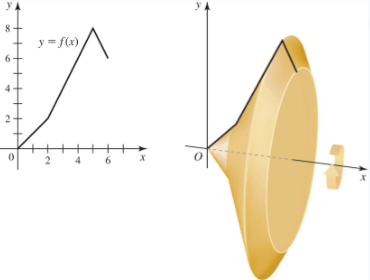
Let f(x) = {x if 0≤x≤2 2x−2 if 2<x≤5 −2x+18 if 5<x≤6.
Find the volume of the solid formed when the region bounded by the graph of f, the x-axis, and the line x=6 is revolved about the x-axis.
Verified step by step guidance
1
Identify the piecewise function \( f(x) \) defined as:
\[
f(x) = \begin{cases}
x & \text{if } 0 \leq x \leq 2 \\
2x - 2 & \text{if } 2 < x \leq 5 \\
-2x + 18 & \text{if } 5 < x \leq 6
\end{cases}
\]
This function describes the height of the region above the x-axis for each interval.
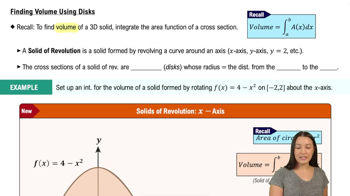
Recall that the volume of the solid formed by revolving the region bounded by \( f(x) \), the x-axis, and the vertical line \( x = 6 \) about the x-axis can be found using the disk method. The volume \( V \) is given by the integral:
\[
V = \pi \int_a^b [f(x)]^2 \, dx
\]
where \( a = 0 \) and \( b = 6 \) in this problem.
Since \( f(x) \) is piecewise, split the integral into three parts corresponding to the intervals:
\[
V = \pi \left( \int_0^2 (x)^2 \, dx + \int_2^5 (2x - 2)^2 \, dx + \int_5^6 (-2x + 18)^2 \, dx \right)
\]
Set up each integral explicitly:
- For \( 0 \leq x \leq 2 \):
\[
\int_0^2 x^2 \, dx
\]
- For \( 2 < x \leq 5 \):
\[
\int_2^5 (2x - 2)^2 \, dx
\]
- For \( 5 < x \leq 6 \):
\[
\int_5^6 (-2x + 18)^2 \, dx
\]
Evaluate each integral separately and then sum the results. Finally, multiply the sum by \( \pi \) to find the total volume of the solid formed by revolving the region about the x-axis.
Verified video answer for a similar problem:
This video solution was recommended by our tutors as helpful for the problem above
Video duration:
7m
Play a video:
0 Comments
Key Concepts
Here are the essential concepts you must grasp in order to answer the question correctly.
Piecewise Functions
A piecewise function is defined by different expressions over distinct intervals of the domain. Understanding how to interpret and work with each piece separately is essential, especially when integrating or analyzing the function over its entire domain.
The volume of a solid formed by revolving a region around an axis can be found using methods like the disk or washer method. This involves integrating the cross-sectional area, typically π[f(x)]², along the axis of revolution.
Definite integration calculates the accumulation of quantities, such as area or volume, over an interval. For solids of revolution, it is used to sum the volumes of infinitesimally thin disks or washers across the given bounds.