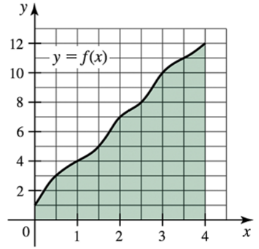
Suppose the region bounded by the curve y=f(x) from x=0 to x=4 (see figure) is revolved about the x-axis to form a solid of revolution. Use left, right, and midpoint Riemann sums, with n=4 subintervals of equal length, to estimate the volume of the solid of revolution.
Verified step by step guidance
1
First, identify the interval over which the solid is formed, which is from \(x=0\) to \(x=4\). Since \(n=4\), divide this interval into 4 equal subintervals. The length of each subinterval is \(\Delta x = \frac{4-0}{4} = 1\).
Next, determine the sample points for the left Riemann sum, right Riemann sum, and midpoint Riemann sum. For the left sum, use the left endpoints of each subinterval: \(x=0, 1, 2, 3\). For the right sum, use the right endpoints: \(x=1, 2, 3, 4\). For the midpoint sum, use the midpoints of each subinterval: \(x=0.5, 1.5, 2.5, 3.5\).
From the graph, estimate the values of \(f(x)\) at each of these sample points. These values represent the radius of the solid at each point since the solid is revolved about the x-axis.
Use the formula for the volume of a solid of revolution using the disk method: \(V \approx \pi \sum_{i=1}^n [f(x_i)]^2 \Delta x\), where \(x_i\) are the sample points chosen (left, right, or midpoint). Calculate the sum of the squares of the function values at the sample points, multiply by \(\pi\) and \(\Delta x\).
Compute the three sums separately using the left endpoints, right endpoints, and midpoints to get three different estimates for the volume. This will give you the left Riemann sum estimate, right Riemann sum estimate, and midpoint Riemann sum estimate for the volume of the solid.
Verified video answer for a similar problem:
This video solution was recommended by our tutors as helpful for the problem above
Video duration:
4m
Play a video:
0 Comments
Key Concepts
Here are the essential concepts you must grasp in order to answer the question correctly.
Solid of Revolution
A solid of revolution is formed when a region in the plane is revolved around an axis, creating a three-dimensional object. In this problem, revolving the area under y = f(x) from x = 0 to x = 4 about the x-axis generates a solid whose volume can be found by integrating the cross-sectional areas perpendicular to the x-axis.
Riemann sums approximate the value of an integral by summing areas of rectangles under a curve. Left sums use the function value at the left endpoint of each subinterval, right sums use the right endpoint, and midpoint sums use the midpoint. These methods provide estimates for the volume when exact integration is difficult.
The disk method calculates the volume of a solid of revolution by summing volumes of thin disks perpendicular to the axis of rotation. Each disk's volume is π[f(x)]²Δx, where f(x) is the radius. Using Riemann sums with these disk volumes approximates the total volume of the solid.