

Ch. 4 - Applications of Derivatives
Hass - Thomas' Calculus 15th Edition
Hass15th EditionThomas' CalculusISBN: 9780137616077Not the one you use?Change textbook
Chapter 4, Problem 4.7.101c

Finding displacement from an antiderivative of velocity
a. Suppose that the velocity of a body moving along the s-axis is
ds/dt = v = 9.8t − 3.
iii. Now find the body’s displacement from t = 1 to t = 3 given that s = s₀ when t = 0.

Verified step by step guidance
1
Identify the given velocity function: \(v(t) = \frac{ds}{dt} = 9.8t - 3\).
Recall that displacement over the time interval \([t_1, t_2]\) is found by integrating the velocity function over that interval: \(\Delta s = \int_{t_1}^{t_2} v(t) \, dt\).
Set up the definite integral for displacement from \(t = 1\) to \(t = 3\): \(\Delta s = \int_{1}^{3} (9.8t - 3) \, dt\).
Find the antiderivative of the velocity function: \(\int (9.8t - 3) \, dt = 4.9t^2 - 3t + C\), where \(C\) is the constant of integration.
Evaluate the definite integral by computing \(\left[4.9t^2 - 3t\right]_{1}^{3} = (4.9 \times 3^2 - 3 \times 3) - (4.9 \times 1^2 - 3 \times 1)\) to find the displacement.

Verified video answer for a similar problem:

This video solution was recommended by our tutors as helpful for the problem above.
Video duration:
2m
Was this helpful?

Key Concepts

Here are the essential concepts you must grasp in order to answer the question correctly.

Velocity and Displacement Relationship

Velocity is the rate of change of displacement with respect to time. Displacement over a time interval can be found by integrating the velocity function over that interval, which accumulates the total change in position.
Recommended video:
06:29
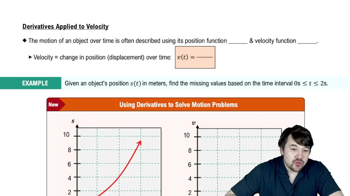
Derivatives Applied To Velocity

Definite Integration

Definite integration calculates the net area under a curve between two limits. In this context, integrating the velocity function from t = 1 to t = 3 gives the total displacement during that time period.
Recommended video:
05:43
Definition of the Definite Integral

Initial Conditions and Antiderivatives

An antiderivative of velocity gives the displacement function plus a constant. Using the initial condition s = s₀ at t = 0 allows determination of this constant, enabling calculation of displacement at any time.
Recommended video:
05:50
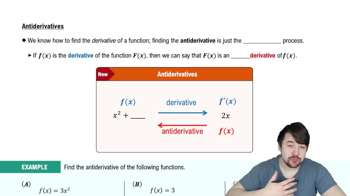
Antiderivatives
Related Practice
Textbook Question

Identifying Extrema


In Exercises 63 and 64, the graph of f' is given. Assume that f has domain (-2, 2).


" style="max-width: 100%; white-space-collapse: preserve;" width="190">


b. Either use the graph to determine which intervals f is positive on and which intervals f is negative on, or explain why this information cannot be determined from the graph.

231
views
Textbook Question

Finding Antiderivatives

In Exercises 1–16, find an antiderivative for each function. Do as many as you can mentally. Check your answers by differentiation.

-sec²(3x/2)

31
views
Textbook Question

Theory and Examples


Sketch the graph of a differentiable function y = f(x) that has a local maximum at (1, 1) and a local minimum at (3, 3).

217
views
Textbook Question

[Technology Exercises] When solving Exercises 14–30, you may need to use appropriate technology (such as a calculator or a computer).

27. Converging to different zeros Use Newton's method to find the zeros of f(x)=4x^4-4x^2 using the given starting values.

c. x_0 = 0.8 and x_0 = 2, lying in (√2/2, ∞)

104
views
Textbook Question

Analyzing Functions from Derivatives


Answer the following questions about the functions whose derivatives are given in Exercises 1–14:

c. At what points, if any, does f assume local maximum or minimum values?


f′(x) = (x − 1)(x + 2)(x − 3)

256
views
Textbook Question

Dependence on Initial Point

8. Using the function shown in the figure, and, for each initial estimate x_0, determine graphically what happens to the sequence of Newton’s method approximations

c. x_0=2

194
views