
By computing the first few derivatives and looking for a pattern, find the following derivatives.
b. d¹¹⁰/dx¹¹⁰ (sin x − 3 cos x)
Verified step by step guidance
1
First, identify the function for which we need to find the 110th derivative: f(x) = sin(x) - 3cos(x).
Compute the first derivative: f'(x) = cos(x) + 3sin(x).
Compute the second derivative: f''(x) = -sin(x) + 3cos(x).
Compute the third derivative: f'''(x) = -cos(x) - 3sin(x).
Observe the pattern in the derivatives: The derivatives repeat every four steps. Use this pattern to determine the 110th derivative by finding the remainder of 110 divided by 4.
Verified video answer for a similar problem:
This video solution was recommended by our tutors as helpful for the problem above
Video duration:
3m
Play a video:
0 Comments
Key Concepts
Here are the essential concepts you must grasp in order to answer the question correctly.
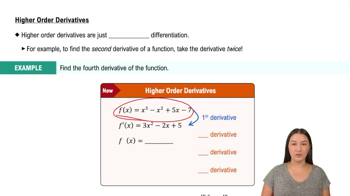
Higher Order Derivatives
Higher order derivatives refer to the derivatives of a function taken multiple times. For example, the second derivative is the derivative of the first derivative. In this problem, you need to compute the 110th derivative, which involves identifying a pattern in the derivatives of the given function.
Understanding the derivatives of trigonometric functions is crucial. The derivative of sin(x) is cos(x), and the derivative of cos(x) is -sin(x). These derivatives repeat in a cycle, which is key to identifying patterns when computing higher order derivatives of trigonometric expressions.
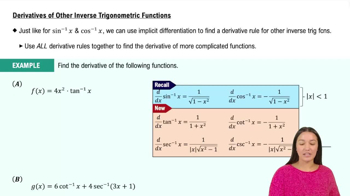
Derivatives of Other Inverse Trigonometric Functions
Pattern Recognition in Derivatives
When computing higher order derivatives, recognizing patterns can simplify the process. For trigonometric functions, derivatives often repeat in cycles. By calculating the first few derivatives, you can identify the cycle length and predict the 110th derivative without computing each one individually.