Find the first and second derivatives of the functions in Exercises 33–38.
s = (t² + 5t − 1) / t²
Verified step by step guidance
1
Step 1: Begin by simplifying the function s = (t² + 5t − 1) / t². This can be rewritten as s = t²/t² + 5t/t² − 1/t², which simplifies to s = 1 + 5/t − 1/t².
Step 2: Differentiate the simplified function s = 1 + 5/t − 1/t² with respect to t to find the first derivative. Use the power rule and the derivative of 1/t and 1/t². The derivative of 1 is 0, the derivative of 5/t is -5/t², and the derivative of -1/t² is 2/t³.
Step 3: Combine the derivatives from Step 2 to express the first derivative of s. The first derivative, s', is s' = 0 - 5/t² + 2/t³.
Step 4: Differentiate the first derivative s' = -5/t² + 2/t³ with respect to t to find the second derivative. Again, use the power rule. The derivative of -5/t² is 10/t³, and the derivative of 2/t³ is -6/t⁴.
Step 5: Combine the derivatives from Step 4 to express the second derivative of s. The second derivative, s'', is s'' = 10/t³ - 6/t⁴.
Verified video answer for a similar problem:
This video solution was recommended by our tutors as helpful for the problem above
Video duration:
4m
Play a video:
0 Comments
Key Concepts
Here are the essential concepts you must grasp in order to answer the question correctly.
Derivatives
A derivative represents the rate of change of a function with respect to a variable. It is a fundamental concept in calculus that allows us to determine how a function behaves at any given point. The first derivative indicates the slope of the tangent line to the curve, while the second derivative provides information about the curvature or concavity of the function.
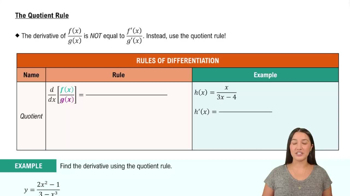
The quotient rule is a method for finding the derivative of a function that is the ratio of two other functions. If you have a function s = f(t) / g(t), the derivative is given by s' = (f' * g - f * g') / g². This rule is essential when differentiating functions that are expressed as fractions, ensuring accurate results.
Simplifying functions involves rewriting them in a more manageable form, often to facilitate differentiation or integration. In the context of the given function s = (t² + 5t − 1) / t², simplifying can help identify terms that can be easily differentiated. This process can reveal insights about the function's behavior and make calculations more straightforward.

 4:15 minutes
 Verified step by step guidance

 05:44
05:44