An object oscillates along a vertical line, and its position in centimeters is given by y(t)=30(sint - 1), where t ≥ 0 is measured in seconds and y is positive in the upward direction. At what times and positions is the velocity zero?
Verified step by step guidance
1
To find when the velocity is zero, we first need to determine the velocity function. The velocity is the derivative of the position function y(t) with respect to time t.
Differentiate y(t) = 30(sin(t) - 1) with respect to t. The derivative of sin(t) is cos(t), and the derivative of a constant is zero. Therefore, the velocity function v(t) is v(t) = 30cos(t).
Set the velocity function equal to zero to find the times when the velocity is zero: 30cos(t) = 0.
Solve the equation cos(t) = 0. The cosine function is zero at odd multiples of π/2, i.e., t = (2n+1)π/2, where n is an integer.
Substitute these values of t back into the original position function y(t) to find the corresponding positions. Calculate y(t) = 30(sin((2n+1)π/2) - 1) for each n to find the positions when the velocity is zero.
Verified video answer for a similar problem:
This video solution was recommended by our tutors as helpful for the problem above
Video duration:
5m
Play a video:
0 Comments
Key Concepts
Here are the essential concepts you must grasp in order to answer the question correctly.
Velocity
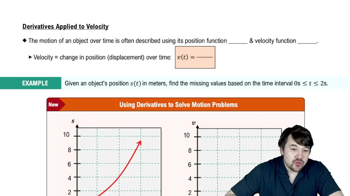
Velocity is the rate of change of an object's position with respect to time. In calculus, it is often represented as the derivative of the position function. For the given function y(t) = 30(sin(t) - 1), the velocity can be found by differentiating this function with respect to time t, yielding v(t) = dy/dt.
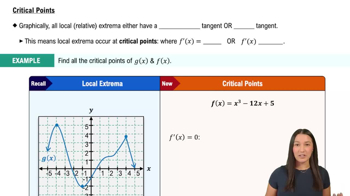
Critical points occur where the derivative of a function is zero or undefined. In the context of the velocity function, finding when the velocity is zero will help identify the times at which the object is momentarily at rest. These points are essential for analyzing the motion of the object and determining its behavior over time.
Oscillation refers to the repetitive variation in position around a central point, often described by sinusoidal functions. In this case, the position function y(t) = 30(sin(t) - 1) indicates that the object oscillates vertically, with its motion influenced by the sine function, which varies between -1 and 1. Understanding oscillation helps in predicting the object's motion and identifying key characteristics such as amplitude and period.

 5:39 minutes
 Verified step by step guidance
 06:29
06:29