27–30. Newton’s Law of Cooling Solve the differential equation for Newton’s Law of Cooling to find the temperature function in the following cases. Then answer any additional questions.
An iron rod is removed from a blacksmith’s forge at a temperature of 900°C . Assume k=0.02 and the rod cools in a room with a temperature of 30°C When does the temperature of the rod reach 100°C?
Verified step by step guidance
1
Identify the form of Newton's Law of Cooling differential equation: \(\frac{dT}{dt} = -k (T - T_{room})\), where \(T\) is the temperature of the object at time \(t\), \(T_{room}\) is the ambient temperature, and \(k\) is a positive constant.
Substitute the given values into the equation: \(k = 0.02\), \(T_{room} = 30\), and the initial temperature \(T(0) = 900\).
Solve the differential equation by separating variables or recognizing it as a first-order linear ODE. The general solution has the form: \(T(t) = T_{room} + (T_0 - T_{room}) e^{-k t}\), where \(T_0\) is the initial temperature.
Plug in the known values to get the temperature function: \(T(t) = 30 + (900 - 30) e^{-0.02 t}\).
To find when the rod reaches 100°C, set \(T(t) = 100\) and solve for \(t\): \$100 = 30 + 870 e^{-0.02 t}\(. Rearrange and solve the resulting equation for \)t$.
Verified video answer for a similar problem:
This video solution was recommended by our tutors as helpful for the problem above
Video duration:
5m
Play a video:
0 Comments
Key Concepts
Here are the essential concepts you must grasp in order to answer the question correctly.
Newton’s Law of Cooling
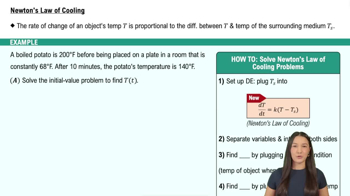
Newton’s Law of Cooling states that the rate of change of an object's temperature is proportional to the difference between its temperature and the ambient temperature. Mathematically, it is expressed as a first-order differential equation: dT/dt = -k(T - T_env), where k is a positive constant.
To find the temperature function, you solve the differential equation by separating variables or using an integrating factor. The solution typically has the form T(t) = T_env + (T_initial - T_env) * e^(-kt), describing how temperature changes over time.
Exponential Decay and Time to Reach a Specific Temperature
The temperature decreases exponentially towards the ambient temperature. To find when the rod reaches 100°C, set T(t) = 100 and solve for t using logarithms, reflecting the time needed for the temperature difference to decay to a certain level.

 5:44 minutes
 Verified step by step guidance
 10:44
10:44