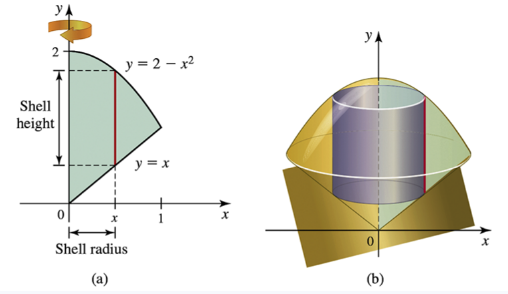
Let R be the region in the first quadrant bounded above by the curve y=2−x² and bounded below by the line y=x. Suppose the shell method is used to determine the volume of the solid generated by revolving R about the y-axis. a. What is the radius of a cylindrical shell at a point x in [0, 2]?
Verified step by step guidance
1
Identify the axis of rotation, which is the y-axis in this problem.
Recall that when using the shell method to revolve a region around the y-axis, the radius of a cylindrical shell at a point x is the horizontal distance from the y-axis to the shell.
Since the y-axis is at x = 0, the radius of the shell at a point x is simply the x-coordinate itself.
Therefore, the radius of a cylindrical shell at a point x in the interval [0, 2] is given by the expression \(x\).
This radius represents the distance from the y-axis to the vertical shell located at x, which will be used in the volume integral.
Verified video answer for a similar problem:
This video solution was recommended by our tutors as helpful for the problem above
Video duration:
3m
Play a video:
0 Comments
Key Concepts
Here are the essential concepts you must grasp in order to answer the question correctly.
Shell Method for Volume Calculation
The shell method calculates the volume of a solid of revolution by summing cylindrical shells formed by revolving vertical slices of a region around an axis. Each shell's volume is approximated by 2π(radius)(height)(thickness), where the radius is the distance from the axis of rotation to the shell, height is the function value difference, and thickness is a small change in x.
In the shell method, the radius of a shell is the distance from the axis of rotation to the vertical slice at a given x-value. When revolving around the y-axis, the radius is simply the x-coordinate of the shell, since the shell is at position x units from the y-axis.
The region R is bounded above by y = 2 - x² and below by y = x in the first quadrant. Understanding these boundaries helps determine the height of each shell as the vertical distance between the two curves at a given x, which is essential for setting up the integral for volume.