9–40. Integration by parts Evaluate the following integrals using integration by parts. 29. ∫ e⁻ˣ sin(4x) dx
Verified step by step guidance
1
Identify the integral to solve: \(\int e^{-x} \sin(4x) \, dx\).
Recall the integration by parts formula: \(\int u \, dv = uv - \int v \, du\).
Choose \(u\) and \(dv\) wisely. For this integral, let \(u = \sin(4x)\) and \(dv = e^{-x} dx\).
Compute \(du\) and \(v\): differentiate \(u\) to get \(du = 4 \cos(4x) dx\), and integrate \(dv\) to get \(v = -e^{-x}\).
Apply the integration by parts formula: substitute \(u\), \(v\), \(du\) into \(\int u \, dv = uv - \int v \, du\), then simplify the resulting integral. You may need to apply integration by parts a second time or solve for the original integral algebraically.
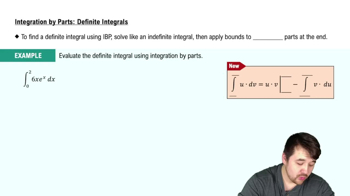
Verified video answer for a similar problem:
This video solution was recommended by our tutors as helpful for the problem above
Video duration:
12m
Play a video:
0 Comments
Key Concepts
Here are the essential concepts you must grasp in order to answer the question correctly.
Integration by Parts
Integration by parts is a technique derived from the product rule of differentiation. It transforms the integral of a product of functions into simpler integrals using the formula ∫u dv = uv - ∫v du. Choosing appropriate u and dv is crucial to simplify the integral effectively.
Integration of Exponential and Trigonometric Functions
Integrals involving products of exponential and trigonometric functions often require repeated application of integration by parts. Recognizing patterns and using algebraic manipulation helps to solve these integrals, especially when the integral reappears during the process.
When integration by parts leads to an integral expression containing the original integral, algebraic techniques are used to isolate and solve for it. This method is common in integrals involving products of exponential and trigonometric functions, enabling the evaluation of otherwise complex integrals.

 12:44 minutes
 Verified step by step guidance
 06:18
06:18