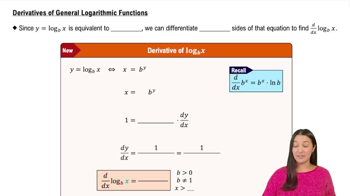
9–40. Integration by parts Evaluate the following integrals using integration by parts. 36. ∫ from 0 to ln2 x eˣ dx
Verified step by step guidance
1
Identify the integral to solve: \(\int_0^{\ln 2} x e^{x} \, dx\).
Choose functions for integration by parts: let \(u = x\) (which simplifies when differentiated) and \(dv = e^{x} dx\) (which is easy to integrate).
Compute the derivatives and integrals needed: \(du = dx\) and \(v = \int e^{x} dx = e^{x}\).
Apply the integration by parts formula: \(\int u \, dv = uv - \int v \, du\), so write \(\int_0^{\ln 2} x e^{x} dx = \left. x e^{x} \right|_0^{\ln 2} - \int_0^{\ln 2} e^{x} dx\).
Evaluate the remaining integral \(\int_0^{\ln 2} e^{x} dx\) and then substitute the limits into both terms to express the final answer.
Verified video answer for a similar problem:
This video solution was recommended by our tutors as helpful for the problem above
Video duration:
3m
Play a video:
0 Comments
Key Concepts
Here are the essential concepts you must grasp in order to answer the question correctly.
Integration by Parts
Integration by parts is a technique derived from the product rule of differentiation. It transforms the integral of a product of functions into simpler integrals using the formula ∫u dv = uv - ∫v du. Choosing u and dv wisely simplifies the integration process.
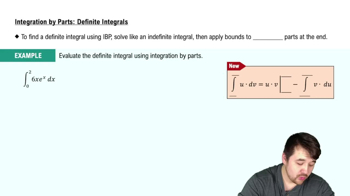
Definite integrals calculate the net area under a curve between two limits. When applying integration by parts to definite integrals, the evaluation of the product uv is done at the upper and lower limits, and the resulting integral is also evaluated within these bounds.
Understanding the properties of exponential functions (eˣ) and logarithmic functions (ln x) is essential. Their derivatives and integrals are well-known, and recognizing these helps in selecting u and dv in integration by parts, especially when limits involve logarithms.

 3:49 minutes
 Verified step by step guidance
 06:18
06:18