 Back
BackApplications of Definite Integrals: The Method of Cylindrical Shells
Study Guide - Smart Notes
 Tailored notes based on your materials, expanded with key definitions, examples, and context.
Applications of Definite Integrals
Introduction to Volume Problems and the Shell Method
In calculus, finding the volume of solids of revolution is a common application of definite integrals. While the washer/disk method is often used, it can become inefficient or algebraically complex when the region is rotated about an axis and the functions must be solved for the 'wrong' variable. In such cases, the method of cylindrical shells provides a more natural and efficient approach.
Washer Method: Requires slices perpendicular to the axis of rotation and may involve solving complicated equations for the variable of integration.
Cylindrical Shell Method: Uses slices parallel to the axis of rotation, allowing integration with respect to the original variable and avoiding complex algebra.
Volumes by Cylindrical Shells
When to Use the Cylindrical Shell Method
The cylindrical shell method is preferred when:
The region is easier to describe using slices parallel to the axis of rotation.
The washer method would require solving complicated equations.
The functions are already given in a convenient form for shells.
Derivation of the Shell Formula
Consider the solid obtained by rotating about the y-axis the region bounded by y = f(x) (where f(x) ≥ 0), y = 0, x = a, and x = b, with b > a ≥ 0. The shell method divides the interval [a, b] into n subintervals of equal width Δx. Each vertical slice at position x forms a cylindrical shell when rotated about the y-axis.
Radius: x
Height: f(x)
Thickness: Δx (or dx in the limit)
The volume of one shell is approximately:
Vi = (circumference) × (height) × (thickness) = 2πx f(x) Δx
Summing over all shells and taking the limit as n → ∞ gives the exact volume:
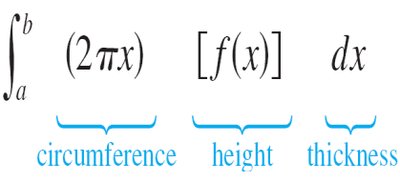
This formula can be remembered by visualizing a typical cylindrical shell cut and flattened into a rectangle, where the length is the circumference (2πx), the height is f(x), and the thickness is dx.
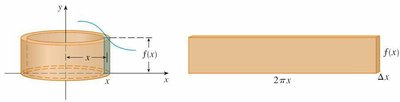
Shell Method Formula (Rotation about the y-axis)
The volume of the solid obtained by rotating about the y-axis the region bounded by y = f(x) (where f(x) ≥ 0), y = 0, x = a, and x = b is:
Worked Examples
Example 1: Rotating a Region Bounded by y = 2x² − x³ and y = 0 about the y-axis
Step 1: Find the x-limits (where the curves meet):
Step 2: Set up shells (vertical slices): Radius: Height:
Step 3: Write and evaluate the integral:
Example 2: Rotating the Region between y = x and y = x² about the y-axis
Intersection points:
On [0, 1],
Radius:
Height:
Volume:
Example 3: Rotating the Region under y = √x from x = 0 to x = 1 about the x-axis
Express x in terms of y:
For ,
Radius:
Height:
Volume:
Example 4: Rotating the Region Bounded by y = x − x² and y = 0 about the Line x = 2
Intersection points:
Radius:
Height:
Volume:
Additional info: The shell method is especially useful when the region is described more naturally in terms of the variable parallel to the axis of rotation, or when the washer method would require solving for the inverse of a function.
