 Back
BackApplications of Definite Integrals: Work, Springs, Lifting, and Pumping Problems
Study Guide - Smart Notes
 Tailored notes based on your materials, expanded with key definitions, examples, and context.
Applications of Definite Integrals
Work Done by a Force
Work in physics is defined as the energy transferred when a force moves an object over a distance. Calculus allows us to compute work when the force is variable or the path is not straight. The basic formula for work when the force is constant and acts in the direction of motion is:
Work Formula (Constant Force):
Units: If is in newtons and in meters, is in joules (J). If $F$ is in pounds and $d$ in feet, $W$ is in foot-pounds (ft-lb).
Example:
Lifting a 1.2-kg book 0.7 m: N, J
Lifting a 20-lb weight 6 ft: ft-lb
Work Done by a Variable Force
When the force varies with position, the work is computed using a definite integral:
Work Formula (Variable Force):
is the force as a function of position
and are the starting and ending positions
Example: A force (in pounds) acts from to feet:
ft-lb
Types of Work Problems in Calculus
Applications of definite integrals to work problems are commonly divided into three types: spring problems, lifting problems, and pumping problems.
Spring Problems (Hooke's Law)
Hooke's Law describes the force required to stretch or compress a spring:
Hooke's Law:
is the spring constant, is the displacement from natural length
Work to stretch/compress from to :
Example: A force of 40 N stretches a spring from 10 cm to 15 cm. Find work to stretch from 15 cm to 18 cm.
Convert to meters: m, m
Find : N/m
Work: J
Lifting Problems
Lifting problems involve raising objects (or parts of objects, like a rope or chain) against gravity. If the force varies (e.g., as the rope shortens), integration is required.
Work Formula:
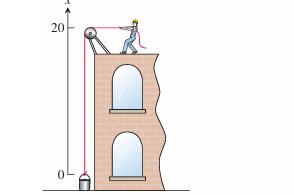
Example: A 5-lb bucket is lifted 20 ft with a rope weighing 0.08 lb/ft. Find the total work done.
Work on bucket: ft-lb
Work on rope: Let be the distance pulled, . Weight of rope remaining: lb.
Work: ft-lb
Total work: ft-lb
Pumping Problems
Pumping problems require calculating the work to move a liquid (such as water) out of a tank. The work depends on the shape of the tank, the weight density of the liquid, and the distance each part of the liquid is moved.
Work Formula for Liquids:
For water (US units): weight density lb/ft
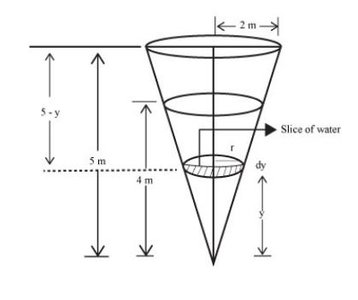
Example: An inverted conical tank (height 5 m, base radius 2 m) is filled with water to a depth of 4 m. Find the work to pump all water to the top. Water density kg/m, m/s.
Let be the vertical distance from the tip (bottom) of the cone,
Each slice must be lifted meters
Weight density: N/m
Radius at height :
Area:
Work for a slice:
Total work: J
Summary Table: Units in Work Problems
Problem Type | Force Unit | Distance Unit | Work Unit |
|---|---|---|---|
Spring problem | N | m | J |
Lifting problem | lb or N | ft or m | ft·lb or J |
Pumping problem | lb/ft³ × ft³ | ft | ft·lb |
