 Back
BackCalculus Chapter 1: Functions, Radian Measure, and Trigonometric Functions
Study Guide - Smart Notes
 Tailored notes based on your materials, expanded with key definitions, examples, and context.
Functions
Definition and Properties of Functions
In calculus, a function is a rule that assigns a single output value to each input value. Functions are fundamental objects in mathematics, especially in calculus, where they are used to describe relationships between varying quantities.
Notation: If the input is x and the function is f, the output is written as f(x).
Graph: The graph of a function f is the set of all points (x, y) in the Cartesian plane such that y = f(x).
Independent and Dependent Variables: The input variable is called the independent variable, and the output is the dependent variable.
Domain Restrictions: Some functions are only defined for certain input values.
Piecewise Functions: Some functions are defined by different formulas for different input values.
Function Notation: It is customary to refer to f(x) rather than just f to avoid ambiguity.
Example: If f(x) = x^2 - x + 1, then f(2) = 2^2 - 2 + 1 = 3.
Inverse Functions
An inverse function reverses the effect of the original function, mapping outputs back to their corresponding inputs. Not all functions have inverses; a function must be one-to-one (injective) for its inverse to exist.
Notation: The inverse of f is denoted f^{-1}.
Example: The exponential function a^x and the logarithmic function \log_a x are inverses: if y = a^x, then x = \log_a y.
Restriction for Inverses: If a function is not one-to-one, its domain may be restricted to ensure the existence of an inverse. For example, \sqrt{x} is the inverse of x^2 restricted to x \geq 0.
Example: The inverse of f(x) = x^2 (for x \geq 0) is f^{-1}(x) = \sqrt{x}.
Radian Measure
Definition and Conversion
Angles can be measured in radians, a natural unit based on the arc length of a circle. One radian is the angle subtended at the center of a circle by an arc whose length equals the radius.
Arc Length Formula:
Conversion: , where \alpha is in degrees and \theta is in radians.
Key Values:
360° = 2\pi radians
180° = \pi radians
90° = \frac{\pi}{2} radians
60° = \frac{\pi}{3} radians
45° = \frac{\pi}{4} radians
30° = \frac{\pi}{6} radians
Example: Convert 60° to radians: radians.
Area of a Sector
The area of a sector of a circle with radius r and angle \theta (in radians) is given by:
Formula:
Example: For a sector with r = 4 and \theta = \frac{1}{2} radians, .
Applications: Goat in a Square Field
Consider a goat tied to the corner of a square field of side 100 m with a rope of length r. The goat can graze an area equal to a quarter circle of radius r plus a region within the square. If the goat is to reach exactly half the grass in the field, we set the grazed area equal to half the area of the square.
Area of Square: m2
Area Grazed:
Set Equal:
Solve for r:
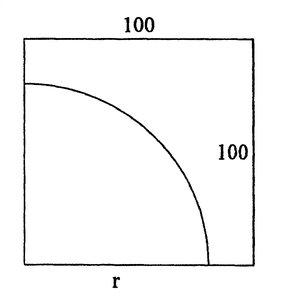
Additional info: This classic problem demonstrates the use of radian measure and area of a sector in a real-world context.
Trigonometric Functions
Definition and Geometric Interpretation
Trigonometric functions relate the angles of a triangle to the lengths of its sides. In the context of the unit circle, they are defined as follows for an angle \theta:
cosine:
sine:
tangent:
On the unit circle (r = 1), the coordinates of a point are (\cos \theta, \sin \theta).
Other Trigonometric Functions
cotangent:
secant:
cosecant:
Key Identities and Properties
Pythagorean Identity:
Other Identities:
Angle Addition:
Double Angle:
Even-Odd Properties:
Solving Trigonometric Equations
Trigonometric equations can be solved by expressing them in terms of sine, cosine, or tangent and using the identities above. The general solutions are:
or
Example: Solve . Use identities to rewrite and solve for \theta.
Standard Angles and Triangles
Values of trigonometric functions for standard angles (such as , , ) are derived from special right triangles and are frequently used in calculus.
Summary Table: Trigonometric Function Values for Standard Angles
Angle (degrees) | Angle (radians) | sin | cos | tan |
|---|---|---|---|---|
30° | ||||
45° | 1 | |||
60° |
Additional info: Mastery of these values and identities is essential for calculus, especially for differentiation and integration involving trigonometric functions.
