 Back
BackCalculus Exam Review: Limits and Derivatives Guidance
Study Guide - Smart Notes
 Tailored notes based on your materials, expanded with key definitions, examples, and context.
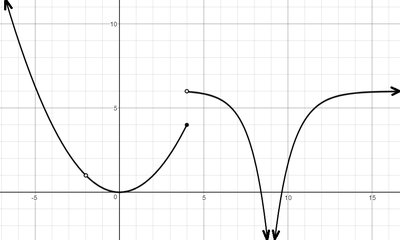
Q2. The graph of y = f(x) is shown above. Find the following limits:
Background
Topic: Limits from a Graph
This question tests your ability to interpret a graph and determine the value of limits at various points, including at infinity, at points of discontinuity, and at specific x-values. You will need to understand one-sided limits, jump discontinuities, and infinite limits.
Key Terms:
Limit: The value that a function approaches as the input approaches a certain point.
One-sided limit: The value the function approaches from one side (left or right) of a point.
Discontinuity: A point where the function is not continuous (can be jump, infinite, or removable).
Limit at infinity: The value the function approaches as x goes to positive or negative infinity.
Step-by-Step Guidance
Examine the graph carefully for each x-value or direction (e.g., , , , , etc.). Identify whether the function is continuous, has a jump, or goes to infinity at each point.
For limits at infinity ( and ), observe the end behavior of the graph. Does the function approach a horizontal asymptote, or does it increase/decrease without bound?
For one-sided limits at , look at the values the function approaches from the left () and from the right (). If the values are different, the two-sided limit does not exist.
For limits at points of discontinuity (such as or ), check if the function jumps, has a hole, or goes to infinity. Use the graph to estimate the value or determine if the limit does not exist.
For other specific x-values (like , ), trace the graph to see what value the function approaches as x gets close to those points.
Try solving on your own before revealing the answer!
Final Answers:
(a)
(b)
(c)
(d)
(e) does not exist, since the left and right limits are not equal.
(f)
(g)
(h)
Each answer is based on the behavior of the graph at the specified points or directions. For two-sided limits, both sides must agree; otherwise, the limit does not exist.
