 Back
BackCalculus Exam Review: Limits and Derivatives Guidance
Study Guide - Smart Notes
 Tailored notes based on your materials, expanded with key definitions, examples, and context.
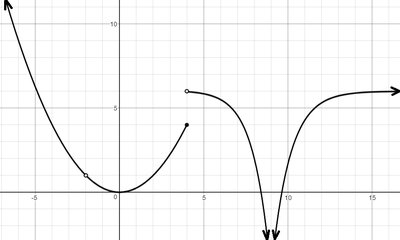
Q2. The graph of y = f(x) is shown above. Find the following limits:
(a)
(b)
(c)
(d)
(e)
(f)
(g)
(h)
Background
Topic: Limits from Graphs
This question tests your ability to interpret limits using a graph, including one-sided limits, limits at infinity, and limits at points of discontinuity.
Key Terms and Concepts:
Limit: The value a function approaches as the input approaches a certain point.
One-sided limits: (from the left), (from the right).
Limit at infinity: or describes end behavior.
Discontinuity: A point where the function is not continuous (jump, removable, or infinite).
Step-by-Step Guidance
For each limit, identify the relevant portion of the graph. For example, for , observe the behavior of the function as moves far to the left.
For one-sided limits (like and ), look at the graph as approaches 4 from the left and right, respectively. Note any jumps or holes.
For , compare the left- and right-hand limits. If they are equal, the limit exists; if not, the limit does not exist.
For limits at points of discontinuity (like or ), check if the function approaches the same value from both sides, or if there is a jump or infinite discontinuity.
For , observe the graph near and see what value the function approaches.
Try solving on your own before revealing the answer!
