 Back
BackCalculus Final Exam Study Guidance
Study Guide - Smart Notes
 Tailored notes based on your materials, expanded with key definitions, examples, and context.
Q1. Calculate the derivatives of the following functions. You do not have to simplify your answer.
Background
Topic: Differentiation (Product Rule, Chain Rule, and Derivative of Trigonometric Functions)
This question tests your ability to apply the rules of differentiation, including the product rule, chain rule, and derivatives of trigonometric and exponential functions.
Key Terms and Formulas
Product Rule:
Chain Rule:
Derivative of :
Derivative of :
Step-by-Step Guidance
Identify which differentiation rules are needed for each part (product rule, chain rule, etc.).
For each function, write down the function and label the parts (e.g., and for the product rule).
Apply the appropriate rule(s) to find the derivative, showing each term separately.
For composite functions, use the chain rule to differentiate the inner and outer functions.
Stop before combining like terms or simplifying the final expression.
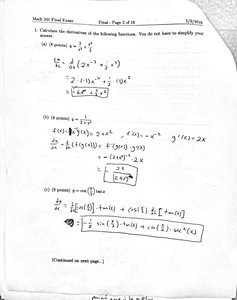
Try solving on your own before revealing the answer!
Final Answer:
Each part's derivative is shown using the appropriate rules. For example, for , the product rule is applied, and for , the derivatives of trigonometric functions are used.
Q2. For each of the following limits, if it exists, compute it. If the limit is infinite, say whether it is or . Do not use L'Hôpital's rule, even if you know it.
Background
Topic: Limits and Continuity
This question tests your understanding of how to evaluate limits algebraically, including factoring, rationalizing, and analyzing the behavior of functions as approaches a certain value.
Key Terms and Formulas
Limit:
Factoring and Simplifying: Used to resolve indeterminate forms like .
Infinity: If the function grows without bound, the limit may be or .
Step-by-Step Guidance
Substitute the value is approaching into the function to check for indeterminate forms.
If you get or , try factoring, rationalizing, or simplifying the expression.
Cancel common factors if possible, then re-evaluate the limit.
If the function approaches infinity, determine the sign based on the direction of approach.
Stop before writing the final numeric value or conclusion.
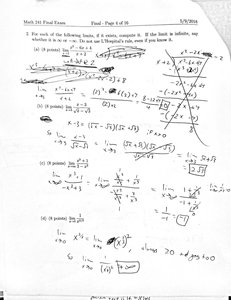
Try solving on your own before revealing the answer!
Final Answer:
The limits are evaluated by factoring and simplifying the expressions, then substituting the value of to find the result.
Q3. Using the limit definition of the derivative, find if .
Background
Topic: Definition of the Derivative
This question tests your understanding of the formal (limit) definition of the derivative and your ability to apply it to a specific function at a given point.
Key Terms and Formulas
Limit Definition of Derivative:
Step-by-Step Guidance
Write the limit definition for using the given function .
Substitute and into the formula.
Simplify the numerator to combine the two fractions.
Factor and simplify the resulting expression to cancel in the denominator.
Stop before taking the limit as .
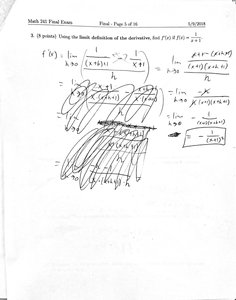
Try solving on your own before revealing the answer!
Final Answer:
After simplifying, the limit gives the value of the derivative at for the function .
Q4. The equation describes the following curve in the plane.
Background
Topic: Implicit Differentiation and Tangent Lines
This question tests your ability to use implicit differentiation to find and to find the equation of the tangent line to a curve at a given point.
Key Terms and Formulas
Implicit Differentiation: Differentiate both sides of the equation with respect to , treating as a function of $x$.
Equation of Tangent Line: , where is the slope at .
Step-by-Step Guidance
Differentiate both sides of the equation with respect to , applying the chain rule to terms involving .
Solve for in terms of and .
Substitute the given point into your expression for to find the slope at that point.
Write the equation of the tangent line using the point-slope form.
Stop before simplifying the tangent line equation.
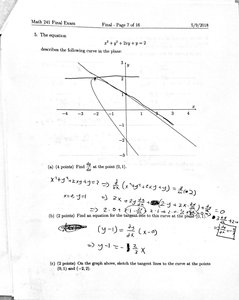
Try solving on your own before revealing the answer!
Final Answer:
The slope and equation of the tangent line are found using implicit differentiation and the point-slope formula.
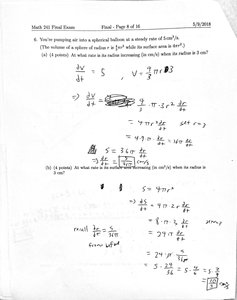
Q5. You're pumping air into a spherical balloon at a steady rate of . (The volume of a sphere of radius is .)
Background
Topic: Related Rates
This question tests your ability to relate the rates of change of different quantities using implicit differentiation and the chain rule.
Key Terms and Formulas
Volume of a Sphere:
Related Rates:
Step-by-Step Guidance
Write the formula for the volume of a sphere and differentiate both sides with respect to time .
Substitute the given rate and the value of as needed.
Solve for , the rate at which the radius is increasing.
Stop before plugging in the final values or calculating the numeric answer.
Try solving on your own before revealing the answer!
Final Answer:
The rate at which the radius is increasing is found by solving for using the related rates equation.
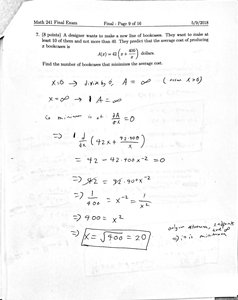
Q6. A designer wants to make a new line of bookcases. They want to make at least 10 of them and not more than 40. They predict that the average cost of producing bookcases is dollars. Find the number of bookcases that minimizes the average cost.
Background
Topic: Optimization
This question tests your ability to find the minimum (or maximum) value of a function, subject to constraints, using calculus.
Key Terms and Formulas
Critical Points: Set to find candidates for minima or maxima.
Endpoints: Check the values at the endpoints of the interval as well.
Step-by-Step Guidance
Find the derivative of the average cost function.
Set and solve for to find critical points.
Check the value of at the critical point(s) and at the endpoints and .
Stop before determining which value gives the minimum average cost.
Try solving on your own before revealing the answer!
Final Answer:
The number of bookcases that minimizes the average cost is found by evaluating at the critical point and endpoints.
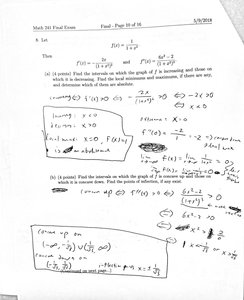
Q7. Let .
Background
Topic: Curve Sketching and Analysis
This question tests your ability to analyze a rational function, including finding intervals of increase/decrease, local extrema, and concavity.
Key Terms and Formulas
First Derivative Test: Use to find intervals of increase/decrease and local extrema.
Second Derivative Test: Use to determine concavity and inflection points.
Step-by-Step Guidance
Find the first derivative and set it equal to zero to find critical points.
Determine the sign of on intervals between critical points and vertical asymptotes.
Find the second derivative and analyze its sign to determine concavity.
Stop before listing all intervals or drawing the final conclusions.
Try solving on your own before revealing the answer!
Final Answer:
The intervals and points of increase/decrease, local extrema, and concavity are determined using the first and second derivatives.
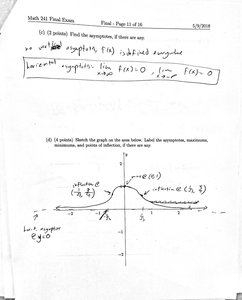
Q8. (a) Find the asymptotes, if there are any. (b) Sketch the graph on the axes below. Label the asymptotes, maximum, minimum, and points of inflection, if there are any.
Background
Topic: Asymptotes and Graph Sketching
This question tests your ability to find vertical and horizontal asymptotes of a rational function and to sketch its graph, labeling key features.
Key Terms and Formulas
Vertical Asymptote: Where the denominator is zero and the function is undefined.
Horizontal Asymptote: The value the function approaches as or .
Step-by-Step Guidance
Set the denominator equal to zero to find vertical asymptotes.
Analyze the degrees of the numerator and denominator to find horizontal asymptotes.
Use previous analysis (from derivatives) to identify maxima, minima, and inflection points.
Stop before drawing the final graph or labeling all features.
Try solving on your own before revealing the answer!
Final Answer:
The asymptotes and key features are identified and labeled on the graph based on the function's analysis.
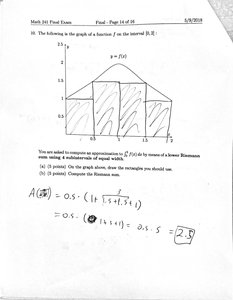
Q9. The following is the graph of a function on the interval . You are asked to compute an approximation to by means of a lower Riemann sum using 4 subintervals of equal width.
Background
Topic: Riemann Sums and Definite Integrals
This question tests your understanding of how to approximate the area under a curve using Riemann sums, specifically the lower sum.
Key Terms and Formulas
Riemann Sum:
Lower Sum: Use the minimum value of on each subinterval.
Width of Subintervals:
Step-by-Step Guidance
Divide the interval into 4 equal subintervals and determine .
For each subinterval, find the minimum value of (from the graph).
Multiply each minimum value by and sum the results.
Stop before adding up the final sum.
Try solving on your own before revealing the answer!
Final Answer:
The lower Riemann sum is computed by summing the areas of the rectangles using the minimum values from each subinterval.
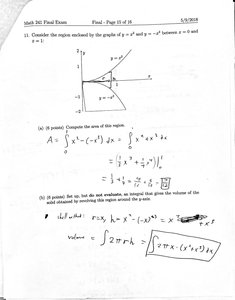
Q10. Consider the region enclosed by the graphs of and between and .
Background
Topic: Area Between Curves and Volumes of Revolution
This question tests your ability to set up integrals to find the area between two curves and the volume of a solid of revolution.
Key Terms and Formulas
Area Between Curves:
Volume of Revolution (Washer Method):
Step-by-Step Guidance
Set up the integral for the area between and from to .
For the volume, identify the outer and inner radii for the washer method and set up the corresponding integral.
Stop before evaluating the integrals.
Try solving on your own before revealing the answer!
Final Answer:
The area and volume are set up as definite integrals using the appropriate formulas for the region and solid of revolution.
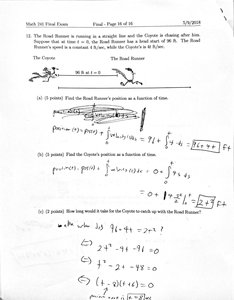
Q11. The Road Runner is running in a straight line and the Coyote is chasing after him. Suppose that at time s, the Road Runner has a head start of 96 ft. The Road Runner's speed is constant (10 ft/s), while the Coyote's is 12 ft/s.
Background
Topic: Motion Problems and Integrals
This question tests your ability to model motion using integrals and solve for position as a function of time, as well as to determine when one object catches up to another.
Key Terms and Formulas
Position Function: for constant velocity.
Relative Motion: Set the positions equal to solve for the time when the Coyote catches up.
Step-by-Step Guidance
Write the position function for both the Road Runner and the Coyote as functions of time.
Set the two position functions equal to each other to find the time when the Coyote catches up.
Stop before solving for the exact value of .
Try solving on your own before revealing the answer!
Final Answer:
The time when the Coyote catches up is found by solving the equation where their positions are equal.
