 Back
BackCalculus I Midterm Exam Study Guide – Step-by-Step Guidance
Study Guide - Smart Notes
 Tailored notes based on your materials, expanded with key definitions, examples, and context.
Q1. Find the limit: \( \lim_{x \to 2} (3x^2 - 5x + 4) \)
Background
Topic: Limits and Continuity
This question tests your understanding of how to evaluate limits of polynomial functions as \( x \) approaches a specific value.
Key Terms and Formulas:
Limit: The value that a function approaches as the input approaches some value.
For polynomials, \( \lim_{x \to a} f(x) = f(a) \) (direct substitution works if the function is continuous at \( a \)).
Step-by-Step Guidance
Recognize that the function \( 3x^2 - 5x + 4 \) is a polynomial, which is continuous everywhere.
Apply the direct substitution property for limits of polynomials: substitute \( x = 2 \) into the function.
Set up the substitution: \( 3(2)^2 - 5(2) + 4 \).
Try solving on your own before revealing the answer!
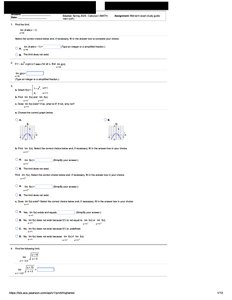
Q2. Suppose f(x) has a vertical asymptote at x = 1. Which of the following could be the graph of f(x)?
Background
Topic: Asymptotes and Graphs of Functions
This question tests your ability to identify vertical asymptotes in the graph of a function.
Key Terms and Formulas:
Vertical Asymptote: A line \( x = a \) where the function grows without bound as \( x \) approaches \( a \).
Step-by-Step Guidance
Recall that a vertical asymptote occurs where the function is undefined and the values approach infinity or negative infinity.
Examine each graph and look for a vertical line at \( x = 1 \) where the function diverges.
Eliminate any graphs that do not have this behavior at \( x = 1 \).
Try solving on your own before revealing the answer!
Q3. Find the derivative of \( f(x) = x^3 - 2x + 1 \).
Background
Topic: Differentiation
This question tests your ability to apply the power rule and sum rule for derivatives.
Key Terms and Formulas:
Derivative: Measures the rate at which a function changes as its input changes.
Power Rule: \( \frac{d}{dx} x^n = n x^{n-1} \)
Sum Rule: The derivative of a sum is the sum of the derivatives.
Step-by-Step Guidance
Apply the power rule to each term: \( x^3 \), \( -2x \), and \( 1 \).
For \( x^3 \), the derivative is \( 3x^2 \).
For \( -2x \), the derivative is \( -2 \).
For the constant \( 1 \), the derivative is \( 0 \).
Combine the results to write the derivative function, but do not simplify to the final answer yet.
Try solving on your own before revealing the answer!
Q4. Evaluate the definite integral: \( \int_0^2 (4x - 1) dx \)
Background
Topic: Definite Integrals
This question tests your ability to compute the definite integral of a linear function over a given interval.
Key Terms and Formulas:
Definite Integral: Represents the signed area under the curve from \( a \) to \( b \).
\( \int_a^b f(x) dx = F(b) - F(a) \), where \( F(x) \) is any antiderivative of \( f(x) \).
Step-by-Step Guidance
Find the antiderivative of \( 4x - 1 \). Recall that the antiderivative of \( x \) is \( \frac{1}{2}x^2 \), and the antiderivative of a constant is the constant times \( x \).
Write the general antiderivative: \( F(x) = 2x^2 - x \).
Apply the Fundamental Theorem of Calculus: \( F(2) - F(0) \).
Set up the expressions for \( F(2) \) and \( F(0) \), but do not compute the final value yet.
Try solving on your own before revealing the answer!
Q5. The function \( f(x) = \frac{1}{x^2} \) is continuous for which values of \( x \)?
Background
Topic: Continuity of Functions
This question tests your understanding of where rational functions are continuous.
Key Terms and Formulas:
Continuous Function: A function is continuous at \( x = a \) if \( \lim_{x \to a} f(x) = f(a) \).
Rational functions are continuous everywhere they are defined (denominator not zero).
Step-by-Step Guidance
Identify the denominator of \( f(x) = \frac{1}{x^2} \), which is \( x^2 \).
Set the denominator not equal to zero: \( x^2 \neq 0 \).
Solve for the values of \( x \) where the function is defined and thus continuous.
Try solving on your own before revealing the answer!
