Back
BackCalculus Study Notes: Limits, Derivatives, and Applications
Study Guide - Smart Notes
 Tailored notes based on your materials, expanded with key definitions, examples, and context.
Chapter 2: Limits and Continuity
2.2 Definition of Limits
The concept of a limit is foundational in calculus, describing the behavior of a function as its input approaches a particular value. The formal definition uses the language of approaching a value arbitrarily closely.
Limit Notation: means that as approaches , approaches .
Existence of a Limit: For a limit to exist at , the left-hand and right-hand limits must both exist and be equal.
Formal (Epsilon-Delta) Definition: For every , there exists a such that if , then .
2.3 Techniques for Evaluating Limits
Several algebraic techniques are used to evaluate limits, especially when direct substitution leads to indeterminate forms such as .
Factoring: Factor numerator and denominator to cancel common terms.
Simplification: Simplify the expression to remove the indeterminate form.
Example: Evaluate .
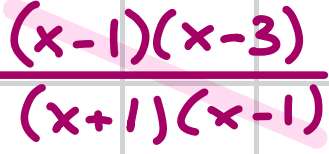
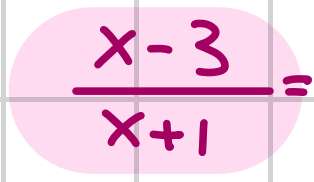
After canceling , the limit simplifies to .
2.4 Infinite Limits and Limits at Infinity
Infinite limits describe the behavior of functions as they grow without bound near a certain point, while limits at infinity describe the behavior as approaches infinity or negative infinity.
Infinite Limit: means increases without bound as approaches .
Limit at Infinity: describes the end behavior of as becomes very large.
2.6 Continuity
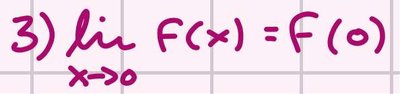
A function is continuous at a point if its limit exists at that point, the function is defined there, and the value of the function equals the limit.
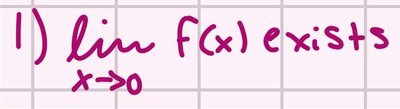
Three Conditions for Continuity at :
exists
is defined
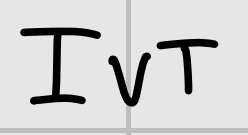
Intermediate Value Theorem (IVT): If is continuous on and is between and , then there exists in such that .
Chapter 4: Applications of the Derivative
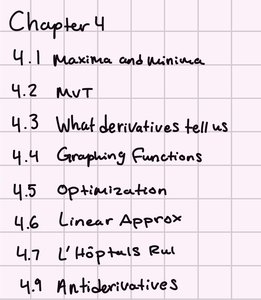
4.1 Maxima and Minima
Maxima and minima are the highest and lowest points on a function, respectively. These points are critical for optimization problems and are found using derivatives.
Critical Points: Points where or does not exist.
Local Maximum/Minimum: Determined by the sign of the first and second derivatives.
4.2 Mean Value Theorem (MVT)
The Mean Value Theorem states that for a function continuous on and differentiable on , there exists in $(a, b)$ such that:
4.3 What Derivatives Tell Us & 4.4 Graphing Functions
Derivatives provide information about the increasing/decreasing behavior of functions and their concavity. This is essential for sketching accurate graphs.
First Derivative Test: Determines intervals of increase/decrease.
Second Derivative Test: Determines concavity and inflection points.
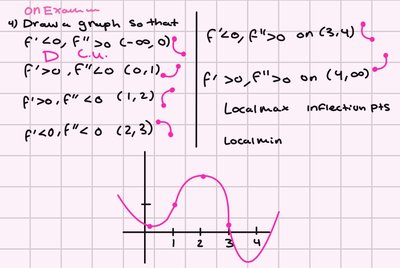
Graphing: Use and to identify local maxima, minima, and inflection points.
Example: Draw a graph so that on , etc.
4.7 L'Hôpital's Rule
L'Hôpital's Rule is used to evaluate limits that result in indeterminate forms such as or by differentiating the numerator and denominator.
Rule: If yields or , then (if the latter limit exists).
4.9 Antiderivatives
An antiderivative of a function is a function such that . Finding antiderivatives is the reverse process of differentiation and is fundamental to integration.
Chapter 5: Integration
5.2 Area Under a Curve
The area under a curve between and is given by the definite integral:
This represents the net area between the function and the -axis.
5.3 Fundamental Theorem of Calculus (FTC)
The Fundamental Theorem of Calculus links differentiation and integration, providing a way to evaluate definite integrals using antiderivatives.
Part 1: If is an antiderivative of , then .
Part 2: .
5.5 Substitution (U-Substitution)
U-substitution is a technique for evaluating integrals by substituting part of the integrand with a new variable to simplify the integral.
Steps:
Let , compute .
Rewrite the integral in terms of and .
Integrate with respect to , then substitute back .
Chapter 6: Applications of Integration
6.2 Area Between Curves
The area between two curves and from to is given by:
This computes the vertical distance between the curves, integrated over the interval.
6.3 Washer and 6.4 Shell Methods
These methods are used to find the volume of solids of revolution.
Washer Method:
Shell Method:
6.5 Arc Length
The arc length of a curve from to is given by:
Appendix: Derivatives of Trigonometric Functions
The derivatives of the six basic trigonometric functions are essential for solving calculus problems involving trigonometric expressions.
Function | Derivative |
|---|---|