 Back
BackComprehensive Study Guide: Derivatives and Applications (MAC2311 Exam 2)
Study Guide - Smart Notes
 Tailored notes based on your materials, expanded with key definitions, examples, and context.
Derivatives: Rules and General Formulas
Basic Derivative Rules
Derivatives are fundamental in calculus, representing the rate of change of a function. The following rules are essential for differentiating various types of functions:
Power Rule: , for real numbers .
Sum Rule:
Difference Rule:
Product Rule:
Quotient Rule:
Chain Rule:
Example: To differentiate , use the chain rule:
Let ,
Derivatives of Trigonometric, Exponential, Logarithmic, and Hyperbolic Functions
Trigonometric Functions
Inverse Trigonometric Functions
Exponential and Logarithmic Functions
Hyperbolic Functions
Applications of Derivatives
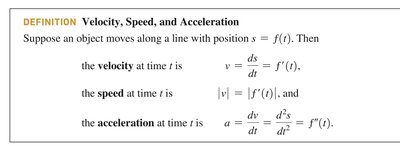
Velocity, Speed, and Acceleration
For an object moving along a line with position :
Velocity:
Speed:
Acceleration:
Finding Tangent Lines
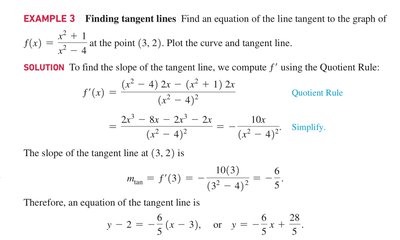
The tangent line to at has slope and passes through . The equation is:
Example: For at :
Compute using the quotient rule.
Find and write the tangent line equation.
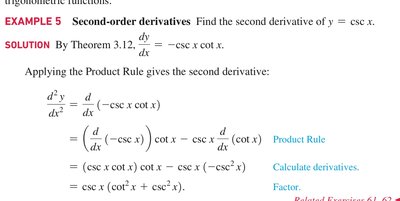
Implicit Differentiation
Used when cannot be explicitly solved in terms of . Differentiate both sides with respect to $x$, treating $y$ as a function of $x$.
Apply chain rule and product rule as needed.
Solve for in terms of and .
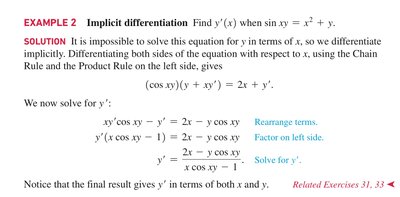
Finding Tangent Lines with Implicit Functions
To find the tangent line to a curve defined implicitly, differentiate both sides, solve for , and substitute the point to find the slope.
Logarithmic Differentiation
Logarithmic differentiation is useful for functions involving products, quotients, or powers. Steps:
Take the natural logarithm of both sides.
Differentiate using chain rule and properties of logarithms.
Solve for .
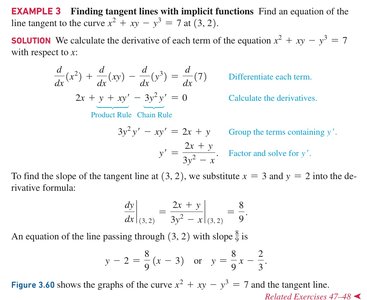
Higher-Order Derivatives
Second and Third Derivatives
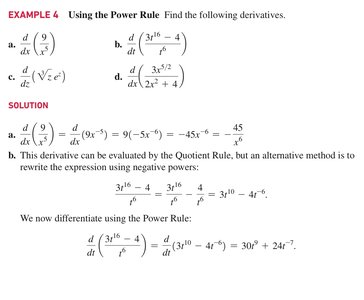
Higher-order derivatives are found by repeatedly differentiating the function. The second derivative measures the rate of change of the first derivative, and so on.
Related Rates
Procedure for Solving Related-Rate Problems
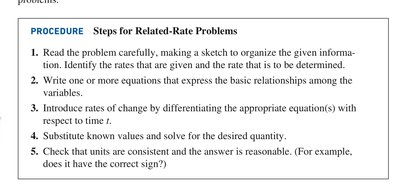
Related rates involve finding the rate at which one quantity changes with respect to another, often time. Steps:
Read the problem carefully and organize information.
Write equations expressing relationships among variables.
Differentiate with respect to time.
Substitute known values and solve.
Check units and reasonableness.
Example: Spreading Oil
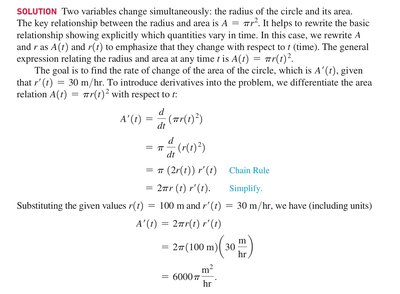
If the radius of an oil patch increases at a rate of 30 m/hr, how fast is the area increasing when the radius is 100 m?
Area:
Substitute , :
m/hr

Example: Distance Between Moving Objects
Using the Pythagorean theorem, relate the rates of change of distances between two moving objects:

Special Derivative Techniques
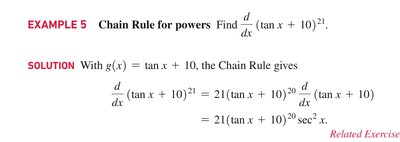
Chain Rule for Powers
When differentiating powers of functions, use the chain rule:
Power Rule Applications
The power rule is used for differentiating functions of the form :
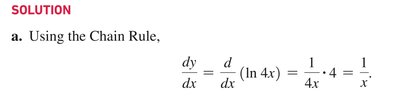
Derivatives Involving Logarithms
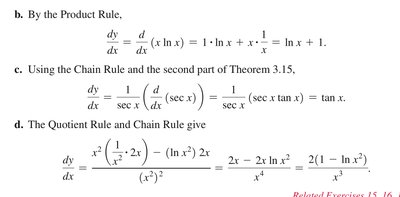
For functions involving logarithms, use the chain rule and product rule as needed:
Derivatives Involving Inverse Trigonometric Functions
Apply the chain rule to differentiate inverse trigonometric functions:
Tables and Calculating Derivatives at Points
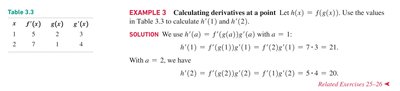
Using Tables to Find Derivatives
Tables can provide values of functions and their derivatives at specific points. Use these values to compute derivatives of combinations of functions.
x | f'(x) | g'(x) |
|---|---|---|
1 | 3 | 2 |
2 | 5 | 4 |
3 | 2 | 3 |
4 | 1 | 1 |
5 | 4 | 5 |

Summary Table: Derivative Rules
Rule | Formula |
|---|---|
Power Rule | |
Product Rule | |
Quotient Rule | |
Chain Rule |
*Additional info: Academic context and examples were expanded for completeness and clarity.*
