 Back
BackContinuity in Calculus: Definitions, Theorems, and Applications
Study Guide - Smart Notes
 Tailored notes based on your materials, expanded with key definitions, examples, and context.
Continuity of Functions
Introduction to Continuity
Continuity is a fundamental concept in calculus that describes the behavior of functions without breaks, jumps, or holes. Understanding continuity is essential for analyzing limits, derivatives, and integrals.
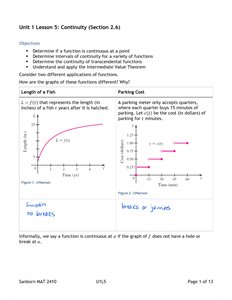
Continuous Function: A function is continuous at a point if its graph does not have a hole or break at that point.
Discontinuous Function: A function is discontinuous at a point if there is a break, jump, or hole in its graph at that point.
Continuity at a Point
Definition and Checklist
A function f is continuous at x = a if the following three conditions are satisfied:
1. f(a) exists.
2. \( \lim_{x \to a} f(x) \) exists.
3. \( \lim_{x \to a} f(x) = f(a) \)
If any of these conditions fail, the function is not continuous at x = a.
Types of Discontinuities
Removable Discontinuity: The limit exists, but the function value is either undefined or not equal to the limit (often called a "hole").
Jump Discontinuity: The left and right limits exist but are not equal (the graph "jumps").
Infinite Discontinuity: The function approaches infinity at the point (vertical asymptote).
Note: Jump and infinite discontinuities are both nonremovable discontinuities.
Identifying Discontinuities from Graphs
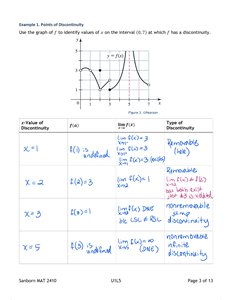
Example: Points of Discontinuity
By analyzing the graph of a function, we can identify the values of x where discontinuities occur and classify their types.
x Value of Discontinuity | f(x) | \( \lim_{x \to a} f(x) \) | Type of Discontinuity |
|---|---|---|---|
x = -1 | f(-1) is undefined | \( \lim_{x \to -1} f(x) = 3 \) | Removable (hole) |
x = 2 | f(2) = 1 | \( \lim_{x \to 2} f(x) = 3 \) | Removable (hole) |
x = 3 | f(3) is undefined | \( \lim_{x \to 3^-} f(x) = 2, \lim_{x \to 3^+} f(x) = -1 \) | Nonremovable (jump) |
x = 5 | f(5) is undefined | \( \lim_{x \to 5^-} f(x) = \infty, \lim_{x \to 5^+} f(x) = -\infty \) | Nonremovable (infinite) |
Testing Continuity Algebraically
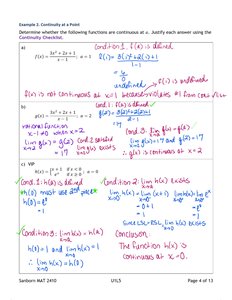
Using the Continuity Checklist
To determine if a function is continuous at a point, check each condition:
Is the function defined at the point?
Does the limit exist as x approaches the point?
Is the value of the function equal to the limit?
Justify each answer using the checklist for specific examples.
Continuity Rules and Theorems
Theorem: Continuity Rules
If f and g are continuous at x = a, then the following are also continuous at x = a:
f + g
f - g
c·f (where c is a constant)
f·g
f/g (provided g(a) ≠ 0)
Theorem: Polynomial and Rational Functions
Polynomial functions are continuous everywhere.
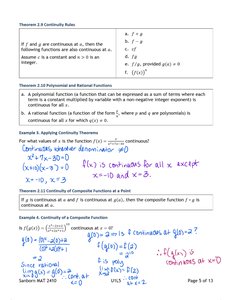
Rational functions are continuous wherever the denominator is not zero.
Continuity of Composite Functions
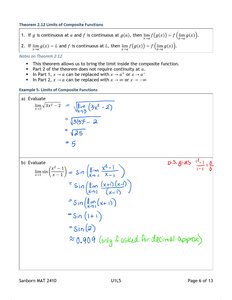
If g is continuous at a and f is continuous at g(a), then the composite function f(g(x)) is continuous at x = a.
Limits of Composite Functions
Theorem: Limits of Composite Functions
If g is continuous at a and f is continuous at g(a), then:
This theorem allows us to bring the limit inside the composite function, simplifying calculations.
Continuity on an Interval
Definitions
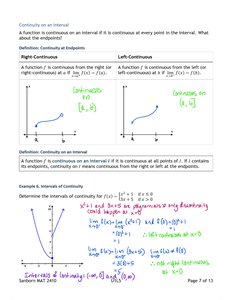
Right-Continuous: A function is right-continuous at a if it is continuous from the right.
Left-Continuous: A function is left-continuous at a if it is continuous from the left.
Continuous on an Interval: A function is continuous on an interval if it is continuous at every point in the interval.
Example: Intervals of Continuity
To determine the interval of continuity for a function, identify where the function is defined and where it is continuous (no breaks, jumps, or holes).
Continuity of Functions Involving Roots
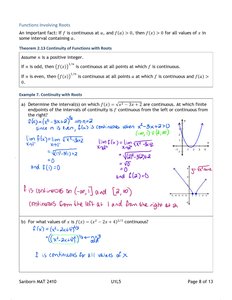
Key Facts
If f is continuous at a and f(a) \geq 0, then is continuous at a for even n.
If n is odd, is continuous wherever f is continuous.
Continuity of Transcendental Functions
Trigonometric Functions
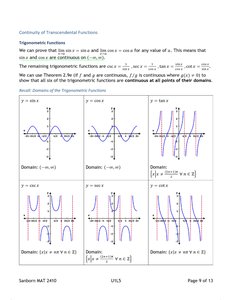
All trigonometric functions are continuous at all points in their domains. For example:
and are continuous for all real numbers.
is continuous wherever .
Exponential and Logarithmic Functions
is continuous for all real numbers.
is continuous for .
Inverse functions of continuous functions are also continuous on their domains.
Intermediate Value Theorem (IVT)
Theorem Statement
If f is continuous on the interval [a, b] and N is any number between f(a) and f(b), then there exists at least one number c in (a, b) such that f(c) = N.
This theorem is useful for proving the existence of solutions to equations within an interval.
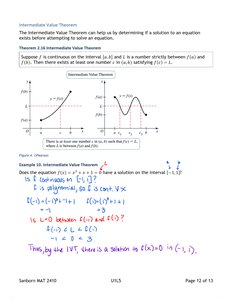
Example: Applying the IVT
Given a continuous function on [a, b], if f(a) and f(b) have opposite signs, there must be a value c in (a, b) where f(c) = 0.
Additional info: These notes cover the essential aspects of continuity, including definitions, types of discontinuities, algebraic and graphical analysis, continuity rules, and the Intermediate Value Theorem, with examples and visual aids for clarity.
