 Back
BackDerivatives as Rates of Change: Velocity, Acceleration, and Marginal Cost
Study Guide - Smart Notes
 Tailored notes based on your materials, expanded with key definitions, examples, and context.
Derivatives as Rates of Change
Introduction
The derivative is a fundamental concept in calculus that measures the rate of change of a function. It is widely used to analyze how quantities change over time or with respect to other variables. In this section, we explore the interpretation of derivatives as rates of change in physical and business contexts, including velocity, acceleration, and marginal cost.
Velocity and Instantaneous Rate of Change
Average and Instantaneous Velocity
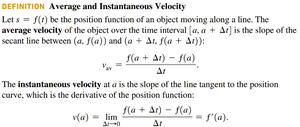
Velocity describes how the position of an object changes over time. The average velocity over a time interval is the slope of the secant line connecting two points on the position curve, while the instantaneous velocity is the slope of the tangent line at a specific point, given by the derivative of the position function.
Average Velocity:
Instantaneous Velocity:
Interpretation: The average velocity is the change in position divided by the change in time, while the instantaneous velocity is the derivative of the position function at a given time.
Velocity, Speed, and Acceleration
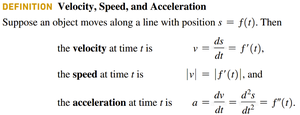
For an object moving along a line with position :
Velocity:
Speed:
Acceleration:
Applications: One-Dimensional Motion
Airline Travel Example
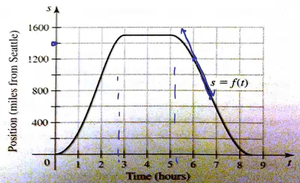
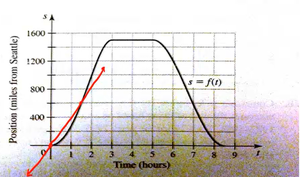
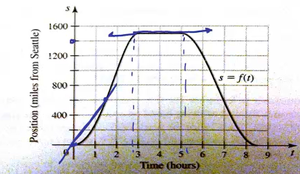
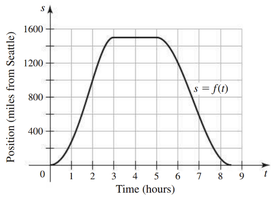
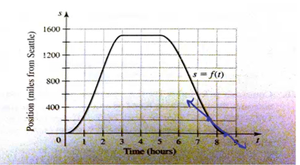
The position function models the distance traveled by an airliner over time. The graph below shows the position as a function of time for a round trip from Seattle to Minneapolis.
Average Velocity (First 1.5 hours): The slope of the secant line from to gives the average velocity during this interval.
Average Velocity (Return Trip): The slope of the secant line from to gives the average velocity during the return trip.
Velocity is Zero: The velocity is zero when the airliner is at rest, corresponding to a horizontal tangent on the position graph (e.g., at the maximum height).
Negative Velocity: When the airliner returns to Seattle, the slope of the tangent line is negative, indicating motion in the opposite direction.
Business Applications: Marginal Cost
Average and Marginal Cost
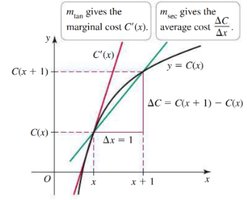
In manufacturing, the cost function gives the total cost to produce items. The average cost is the total cost divided by the number of items, and the marginal cost is the derivative of the cost function, representing the approximate cost to produce one additional item.
Average Cost:
Marginal Cost:
Interpretation: Marginal cost estimates the cost of producing one more item after items have already been produced.

Graphical Interpretation of Marginal and Average Cost
The slope of the tangent line to the cost curve at gives the marginal cost, while the slope of the secant line between and gives the average cost of producing one additional item.
Summary Table: Velocity, Speed, Acceleration, and Cost Functions
Concept | Definition | Formula |
|---|---|---|
Average Velocity | Change in position over change in time | |
Instantaneous Velocity | Derivative of position function | |
Speed | Absolute value of velocity | |
Acceleration | Derivative of velocity | |
Average Cost | Total cost divided by number of items | |
Marginal Cost | Derivative of cost function |
Examples and Applications
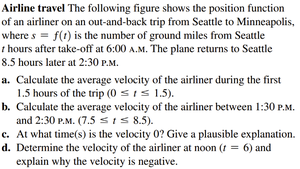
Example: Airline Travel
Given the position function for an airliner, calculate:
Average velocity during the first 1.5 hours
Average velocity during the return trip (7.5 to 8.5 hours)
Times when velocity is zero (airliner at rest)
Velocity at noon (), explaining why it is negative
Example: Marginal Cost in Manufacturing
Suppose the cost function is given. The average cost decreases as more items are produced, and the marginal cost decreases linearly if the cost function is linear. Marginal cost is used to estimate the cost of producing one additional item.
Conclusion
Derivatives provide powerful tools for analyzing rates of change in both physical and business contexts. Understanding the distinction between average and instantaneous rates, as well as their graphical interpretations, is essential for solving real-world problems in calculus.
