 Back
BackDifferentiation Rules and Applications in Calculus I
Study Guide - Smart Notes
 Tailored notes based on your materials, expanded with key definitions, examples, and context.
Chapter 3: Derivatives
Section 3.3: Differentiation Rules
This section introduces fundamental rules for differentiating functions efficiently, without the need to compute limits for each case. Mastery of these rules is essential for solving a wide range of calculus problems.
Basic Derivative Rules
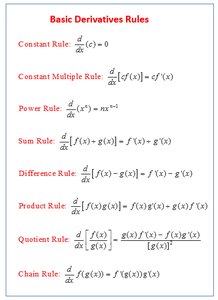
The following rules form the foundation for differentiating most functions encountered in Calculus I:
Constant Rule: The derivative of a constant is zero.
Constant Multiple Rule: The derivative of a constant times a function is the constant times the derivative of the function.
Power Rule: The derivative of is .
Sum Rule: The derivative of a sum is the sum of the derivatives.
Difference Rule: The derivative of a difference is the difference of the derivatives.
Product Rule: The derivative of a product is given by:
Quotient Rule: The derivative of a quotient is:
Chain Rule: The derivative of a composite function is:
Examples: Differentiating Functions Using Rules
These examples illustrate the application of the basic derivative rules:
Example 1: Apply the power rule:
Example 2: Apply the constant rule:
Example 3: Apply the constant multiple and power rules:
Example 4: Differentiate term by term:
Example 5: Rewrite as , then apply the power rule:
Product and Quotient Rule Applications
When functions are multiplied or divided, use the product or quotient rule:
Example 6: Apply the quotient rule:
Example 7: Apply the product rule:
Derivative of the Exponential Function
Exponential functions have unique differentiation properties:
Example 8: Differentiate each term:
Example 9: Apply the product rule:
Higher Order Derivatives
Higher order derivatives are obtained by repeatedly differentiating a function. The second derivative, , describes the rate of change of the rate of change, often used to analyze concavity and inflection points.
Example 10: First derivative: Second derivative:
Example 11: First derivative: Second derivative:
Example 12: First derivative (product rule): Second derivative:
Derivatives of All Orders
Some functions allow for the computation of derivatives of all orders, which can be useful in Taylor series and advanced calculus applications.
Example 13: First derivative: Second derivative: Third derivative: Fourth derivative:
Horizontal Tangent Lines
A curve has a horizontal tangent line where its derivative equals zero. This is often used to find local maxima, minima, or points of inflection.
Example 14: Find and solve : Set $y' = 0$: Solutions: Thus, horizontal tangents occur at .
