 Back
BackEquations of Lines and Planes: Vector, Parametric, and Cartesian Forms
Study Guide - Smart Notes
 Tailored notes based on your materials, expanded with key definitions, examples, and context.
Unit 8: Equations of Lines and Planes
Overview
This unit explores the mathematical representation of lines and planes in three-dimensional space, focusing on vector, parametric, and Cartesian equations. These concepts are foundational in multivariable calculus and are essential for understanding geometry in higher dimensions.
Vector and Parametric Equations of a Line in \( \mathbb{R}^3 \)
Vector, Parametric, and Symmetric Equations of a Line
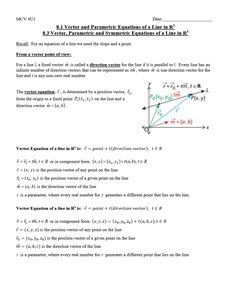
Lines in space can be described using vectors and parameters. The direction vector indicates the line's orientation, while a position vector locates a specific point on the line.
Vector Equation: For a point \( \mathbf{a} \) and direction vector \( \mathbf{m} \), the vector equation is: where \( t \) is a real parameter.
Parametric Equations: The vector equation can be split into parametric equations for each coordinate: where \( (x_0, y_0, z_0) \) is a point on the line and \( (a, b, c) \) are the direction numbers.
Symmetric Equation: By solving for \( t \) in each parametric equation and equating, we obtain:
Example: A line passing through \( (2, 7, 5) \) with direction vector \( (7, 4, 5) \): Vector equation: Parametric equations: , ,
Cartesian Equation of a Line
Definition and Construction
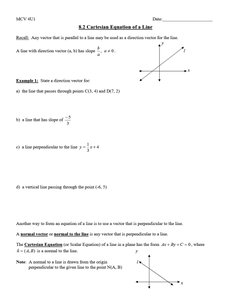
The Cartesian equation expresses a line in terms of its slope or direction vector. Any vector parallel to the line can serve as a direction vector.
Cartesian Equation: In two dimensions, the Cartesian equation is: In three dimensions, it is often derived from the symmetric form.
Perpendicular Lines: A vector normal to the line is perpendicular to its direction vector.
Example: State a direction vector for a line passing through \( (3, 4) \) and perpendicular to \( y = 2x \).
Parallel and Perpendicular Lines and Their Normals
Properties and Angle Calculation
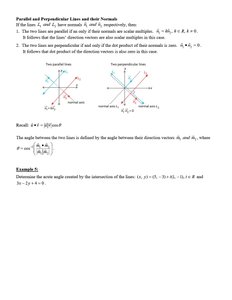
Lines are parallel if their direction vectors are scalar multiples. They are perpendicular if the dot product of their direction vectors is zero.
Parallel Lines: for some scalar \( k \).
Perpendicular Lines:
Angle Between Lines:
Example: Determine the angle between two lines given their direction vectors.
Vector and Parametric Equations of a Plane
Definition and Representation
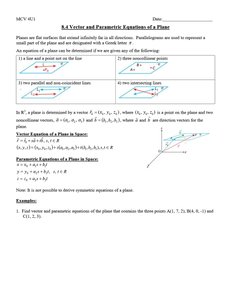
A plane in space can be defined by a point and two non-collinear direction vectors. The vector equation describes all points in the plane.
Vector Equation: where \( \mathbf{a} \) is a point on the plane, \( \mathbf{m}_1 \) and \( \mathbf{m}_2 \) are direction vectors, and \( s, t \) are real parameters.
Parametric Equations:
Example: Find the vector and parametric equations of a plane containing three points.
Cartesian Equation of a Plane
Definition and Normal Vector
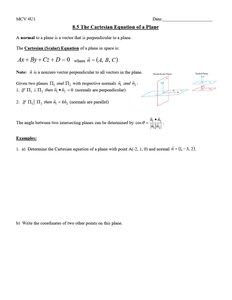
The Cartesian equation of a plane uses a normal vector, which is perpendicular to the plane. The equation is:
Cartesian Equation: where \( (A, B, C) \) is the normal vector.
Finding the Normal: The normal vector can be found using the cross product of two direction vectors in the plane.
Angle Between Planes:
Example: Determine the Cartesian equation of a plane given three points.
Summary Table: Forms of Line and Plane Equations
Type | Vector Equation | Parametric Equation | Symmetric/Cartesian Equation |
|---|---|---|---|
Line | , , | ||
Plane | , , |
Key Concepts and Applications
Direction Vector: Indicates the orientation of a line or plane.
Normal Vector: Perpendicular to a plane; used in Cartesian equations.
Dot Product: Used to determine perpendicularity.
Cross Product: Used to find a normal vector to a plane.
Applications: Geometry, physics, engineering, and computer graphics.
