 Back
BackExam 2 Review for Calculus I – Step-by-Step Guidance
Study Guide - Smart Notes
 Tailored notes based on your materials, expanded with key definitions, examples, and context.
Q1. Use derivative rules to find the derivative of .
Background
Topic: Product Rule, Power Rule, and Derivative of Sums
This question tests your ability to apply the product rule, power rule, and sum rule for derivatives to a function that is a product of two expressions.
Key Terms and Formulas
Product Rule:
Power Rule:
Sum Rule:
Step-by-Step Guidance
Rewrite as to make differentiation easier.
Let and .
Find using the power rule: .
Find by differentiating each term: and .
Set up the product rule: , but do not expand or simplify yet.
Try solving on your own before revealing the answer!
Q2. Find an equation of the line tangent to at .
Background
Topic: Tangent Lines, Product Rule, Trigonometric Derivatives
This question tests your ability to find the equation of a tangent line to a function at a specific point, which involves finding the derivative and evaluating it at a given -value.
Key Terms and Formulas
Tangent Line Equation:
Product Rule:
Derivative of :
Step-by-Step Guidance
Let and , then apply the product rule to find .
Compute and : , .
Plug into to find the -coordinate of the point of tangency.
Plug into to find the slope of the tangent line.
Set up the tangent line equation using the point and the slope, but do not simplify or solve for yet.
Try solving on your own before revealing the answer!
Q3. Suppose and . Let . Find the equation of the tangent line to at .
Background
Topic: Chain Rule, Product Rule, Tangent Lines
This question tests your ability to use the product and chain rules to differentiate a composite function, and then use that derivative to find a tangent line.
Key Terms and Formulas
Product Rule:
Chain Rule:
Tangent Line Equation:
Step-by-Step Guidance
Let and , then apply the product rule to find .
Use the chain rule to differentiate : .
Evaluate using the given values for .
Evaluate using the given values for and .
Set up the tangent line equation at , but do not simplify or solve for yet.
Try solving on your own before revealing the answer!
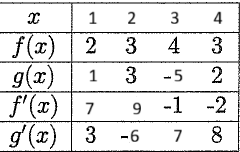
Q4. Use the table to find the following:
Background
Topic: Derivatives from Tables, Product Rule, Tangent Lines
This question tests your ability to use tabular data to compute derivatives and tangent lines for functions defined in terms of and .
Key Terms and Formulas
Product Rule:
Tangent Line Equation:
Step-by-Step Guidance
For (a), use the constant multiple rule: , then evaluate at using the table.
For (b), use the product rule for , then substitute and use the table values for and .
For (c), if , use the quotient rule to find and evaluate at using the table.
Set up the tangent line equation for (c) using the values found, but do not simplify or solve for yet.
Try solving on your own before revealing the answer!
Q5. Find the derivatives of the following functions:
Background
Topic: Basic Derivative Rules, Chain Rule, Trigonometric and Logarithmic Derivatives
This question tests your ability to apply the chain rule, power rule, and derivatives of trigonometric and logarithmic functions.
Key Terms and Formulas
Derivative of :
Chain Rule:
Derivative of : Use chain rule with
Derivative of :
Step-by-Step Guidance
For each part, identify the outer and inner functions and apply the appropriate rule (chain, product, etc.).
For (a), rewrite as and use the chain rule.
For (b), recognize as and use the chain rule.
For (c), apply the chain rule to .
For (d), use the chain rule for .
For (e), apply the chain rule to .
Try solving on your own before revealing the answer!
Q6. Implicitly differentiate the following equations to find :
Background
Topic: Implicit Differentiation
This question tests your ability to use implicit differentiation to find when is not isolated.
Key Terms and Formulas
Implicit Differentiation: Differentiate both sides with respect to , treating as a function of .
Product Rule and Chain Rule may be needed.
Step-by-Step Guidance
For (a), differentiate both sides of with respect to , remembering to use the product rule on and chain rule on .
Collect all terms involving on one side of the equation.
Factor out and set up the equation to solve for it, but do not isolate yet.
For (b), differentiate both sides of with respect to , using the chain rule for and product rule as needed.
Collect and factor as above, but do not solve for yet.
Try solving on your own before revealing the answer!
Q7. For the implicitly defined curve , find .
Background
Topic: Second Derivative, Implicit Differentiation
This question tests your ability to find the second derivative of with respect to for an implicitly defined curve.
Key Terms and Formulas
First, find using implicit differentiation.
Then, differentiate with respect to again, using the chain rule as needed.
Step-by-Step Guidance
Differentiate both sides of with respect to to find .
Express in terms of and .
Differentiate with respect to again, using the chain rule for as a function of .
Set up the expression for , but do not simplify or solve for it yet.
Try solving on your own before revealing the answer!
Q8. Find the derivative of .
Background
Topic: Product Rule, Trigonometric Derivatives
This question tests your ability to use the product rule and derivatives of trigonometric functions.
Key Terms and Formulas
Product Rule:
Step-by-Step Guidance
Let and , then apply the product rule.
Find and using the trigonometric derivatives above.
Set up the expression for using the product rule, but do not simplify yet.
Try solving on your own before revealing the answer!
Q9. Suppose the position (in feet) of a football thrown upwards vertically at any time (seconds) is . Find the velocity and acceleration functions.
Background
Topic: Derivatives as Velocity and Acceleration
This question tests your understanding of how the first derivative of position gives velocity, and the second derivative gives acceleration.
Key Terms and Formulas
Velocity:
Acceleration:
Step-by-Step Guidance
Differentiate with respect to to find .
Differentiate with respect to to find .
Write the expressions for and , but do not simplify or evaluate them yet.
Try solving on your own before revealing the answer!
Q10. A 15-foot ladder leans against a vertical wall. The bottom of the ladder is sliding away from the wall at a rate of 2 feet per second.
Background
Topic: Related Rates
This question tests your ability to use related rates to solve problems involving changing quantities in geometric situations.
Key Terms and Formulas
Pythagorean Theorem:
Related Rates: Differentiate both sides with respect to to relate and .
Angle Rate: is the angle between the ladder and the ground.
Step-by-Step Guidance
Let be the distance from the wall to the bottom of the ladder, be the height on the wall, and the angle with the ground.
Differentiate with respect to to relate and .
Plug in and to set up the equation for , but do not solve for yet.
For the angle, use and differentiate with respect to to relate to .
Set up the equation for , but do not solve for it yet.
Try solving on your own before revealing the answer!
Q11. Air is being pumped into a spherical balloon at a rate of 100 cm/s. How fast is the diameter of the balloon increasing when the radius is 5 cm?
Background
Topic: Related Rates, Volume of a Sphere
This question tests your ability to relate the rate of change of volume to the rate of change of diameter using related rates.
Key Terms and Formulas
Volume of a sphere:
Diameter:
Related Rates:
Step-by-Step Guidance
Differentiate with respect to to relate and .
Plug in and to set up the equation for , but do not solve for yet.
Since , ; set up this relationship but do not solve for yet.
Try solving on your own before revealing the answer!
