 Back
BackHyperbolic Functions: Definitions, Properties, Calculus, and Applications
Study Guide - Smart Notes
 Tailored notes based on your materials, expanded with key definitions, examples, and context.
Hyperbolic Functions
Introduction to Hyperbolic Functions
Hyperbolic functions are a special class of exponential functions that play a significant role in various fields such as fluid dynamics, projectile motion, architecture, and electrical engineering. They are analogous to trigonometric functions but are based on the geometry of the hyperbola rather than the circle.
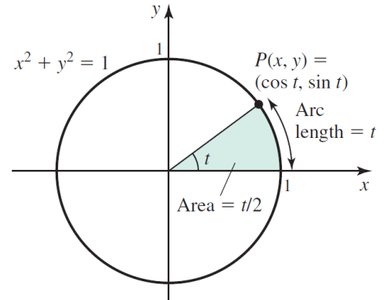
Trigonometric functions are based on the unit circle: $x^2 + y^2 = 1$.
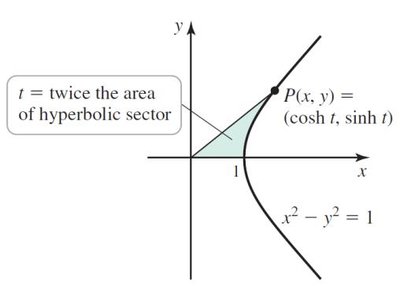
Hyperbolic functions are based on the unit hyperbola: $x^2 - y^2 = 1$.
The hyperbolic cosine and sine correspond to the coordinates of a point on the hyperbola, similar to how cosine and sine correspond to coordinates on the circle.
Definitions of Hyperbolic Functions
The six primary hyperbolic functions are defined as follows:
Hyperbolic Cosine: $\cosh x = \frac{e^x + e^{-x}}{2}$
Hyperbolic Sine: $\sinh x = \frac{e^x - e^{-x}}{2}$
Hyperbolic Tangent: $\tanh x = \frac{\sinh x}{\cosh x} = \frac{e^x - e^{-x}}{e^x + e^{-x}}$
Hyperbolic Cotangent: $\coth x = \frac{\cosh x}{\sinh x} = \frac{e^x + e^{-x}}{e^x - e^{-x}}$
Hyperbolic Secant: $\sech x = \frac{1}{\cosh x} = \frac{2}{e^x + e^{-x}}$
Hyperbolic Cosecant: $\csch x = \frac{1}{\sinh x} = \frac{2}{e^x - e^{-x}}$
Properties and Identities of Hyperbolic Functions
Hyperbolic functions satisfy several important identities, similar to trigonometric identities:
$\cosh^2 x - \sinh^2 x = 1$
$\tanh^2 x + \sech^2 x = 1$
$\coth^2 x - \csch^2 x = 1$
$\sinh(x+y) = \sinh x \cosh y + \cosh x \sinh y$
$\cosh(x+y) = \cosh x \cosh y + \sinh x \sinh y$
$\sinh 2x = 2 \sinh x \cosh x$
$\cosh 2x = \cosh^2 x + \sinh^2 x$
Graphs of Hyperbolic Functions
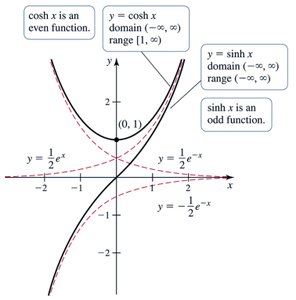
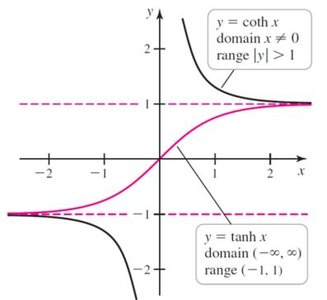
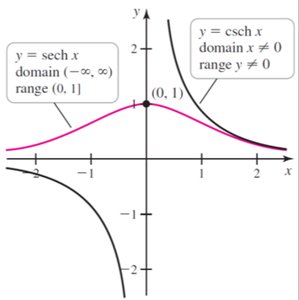
The graphs of hyperbolic functions reveal their unique properties, such as symmetry and domain/range characteristics.
$y = \cosh x$ is an even function, domain $(-\infty, \infty)$, range $[1, \infty)$.
$y = \sinh x$ is an odd function, domain $(-\infty, \infty)$, range $(-\infty, \infty)$.
$y = \tanh x$ domain $(-\infty, \infty)$, range $(-1, 1)$.
$y = \coth x$ domain $x \neq 0$, range $|y| > 1$.
$y = \sech x$ domain $(-\infty, \infty)$, range $(0, 1]$.
$y = \csch x$ domain $x \neq 0$, range $y \neq 0$.
Calculus of Hyperbolic Functions
Derivatives and Integrals
The derivatives and integrals of hyperbolic functions are analogous to those of trigonometric functions. Let $u$ be a differentiable function of $x$:
$\frac{d}{dx}[\sinh u] = (\cosh u) u'$ $\int \cosh u \, du = \sinh u + C$
$\frac{d}{dx}[\cosh u] = (\sinh u) u'$ $\int \sinh u \, du = \cosh u + C$
$\frac{d}{dx}[\tanh u] = (\sech^2 u) u'$ $\int \sech^2 u \, du = \tanh u + C$
$\frac{d}{dx}[\coth u] = -(\csch^2 u) u'$ $\int \csch^2 u \, du = -\coth u + C$
$\frac{d}{dx}[\sech u] = -(\sech u \tanh u) u'$ $\int \sech u \tanh u \, du = -\sech u + C$
$\frac{d}{dx}[\csch u] = -(\csch u \coth u) u'$ $\int \csch u \coth u \, du = -\csch u + C$
Integral Formulas for Hyperbolic Functions
$\int \tanh x \, dx = \ln \cosh x + C$
$\int \coth x \, dx = \ln|\sinh x| + C$
$\int \sech x \, dx = \tan^{-1}(\sinh x) + C$
$\int \csch x \, dx = \ln|\tanh(\frac{x}{2})| + C$
Examples
Evaluating Hyperbolic Functions:
$\sinh(0) = 0$
$\cosh(\ln 2) = \frac{e^{\ln 2} + e^{-\ln 2}}{2} = \frac{2 + 1/2}{2} = \frac{5}{4}$
Writing Tangent Lines:
For $y = \cosh x$ at $x = \ln 2$, the tangent line is $y = \cosh(\ln 2) + \sinh(\ln 2)(x - \ln 2)$.
Finding Derivatives:
$f(x) = \cosh(8x + 1) \rightarrow f'(x) = 8 \sinh(8x + 1)$
$f(x) = (x^2 + 1) \coth x^3 \rightarrow f'(x) = 2x \coth x^3 + (x^2 + 1) \cdot (-\csch^2 x^3) \cdot 3x^2$
Finding Indefinite Integrals:
$\int \frac{\sinh x}{1 + \cosh x} dx$
$\int \sech^2 5x dx = \frac{1}{5} \tanh 5x + C$
Evaluating Definite Integrals:
$\int_0^{\ln 2} \cosh(x) \sinh(x) dx$
$\int_{5/3}^2 \csch(3x-4) \coth(3x-4) dx$
Applications of Hyperbolic Functions
Catenary Curve
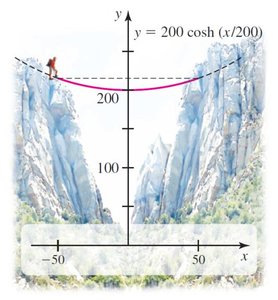
The catenary is the shape of a curve formed by a free-hanging rope or cable attached at two points of equal height. Its equation is $y = a \cosh(\frac{x}{a})$, where $a \neq 0$ is a real number. When $a < 0$, the curve is called an inverted catenary, often used in architectural designs.
Example: A climber anchors a rope at two points separated by 100 ft, following $f(x) = 200 \cosh(\frac{x}{200})$ over $[-50, 50]$. The length of the rope is found using the arc length formula: $L = \int_a^b \sqrt{1 + [f'(x)]^2} dx$
Summary Table: Hyperbolic Functions
Function | Definition | Domain | Range | Parity |
|---|---|---|---|---|
cosh x | $\frac{e^x + e^{-x}}{2}$ | $(-\infty, \infty)$ | $[1, \infty)$ | Even |
sinh x | $\frac{e^x - e^{-x}}{2}$ | $(-\infty, \infty)$ | $(-\infty, \infty)$ | Odd |
tanh x | $\frac{\sinh x}{\cosh x}$ | $(-\infty, \infty)$ | $(-1, 1)$ | Odd |
coth x | $\frac{\cosh x}{\sinh x}$ | $x \neq 0$ | $|y| > 1$ | Odd |
sech x | $\frac{1}{\cosh x}$ | $(-\infty, \infty)$ | $(0, 1]$ | Even |
csch x | $\frac{1}{\sinh x}$ | $x \neq 0$ | $y \neq 0$ | Odd |
Additional info: Hyperbolic functions are essential in advanced calculus, especially in integration techniques and differential equations, and their geometric interpretation provides insight into their properties and applications.
